

Business Transformation Requires Transformational Leaders
Leadership and teaming skills are front and center in times of rapid change. Meet today’s constant disruption head on with expert guidance in leadership, business strategy, transformation, and innovation. Whether the disruption du jour is a digitally-driven upending of traditional business models, the pandemic-driven end to business as usual, or the change-driven challenge of staffing that meets your transformation plans — you’ll be prepared with cutting edge techniques and expert knowledge that enable strategic leadership.
Subscribe to Arthur D. Little's Culture & Leadership Newsletter
Insight
Every software executive that faces the decision whether or not to ship code must answer the question, "Do the economic benefits of shipping outweigh the economic risks?" To decide, the executive must have a view of each. The hoped-for benefits are clear in that they are up front in the decision to build the software. They can include revenue, meeting contractual obligations, enterprise efficiency, or supporting some enterprise initiative such as a new service offering.
Executive Update
The 3Ds: A Strategic Data Virtualization Methodology
Conventional data management approaches have always emphasized the physical movement of data across enterprise systems. Data virtualization (DV) introduced a paradigm shift to this approach by virtue of not physically moving data. This innovative approach has successfully addressed some of the shortcomings of the conservative approach. However, DV is not a silver bullet for all data management issues and presents its own set of challenges, as we will explore in this Executive Update.




Organizations can build resiliency in their employees by helping them successfully adapt to change. Resilient organizations are not satisfied with the status quo and continually seek opportunities for constructive change.


In a previous Advisor (see "Database Futures I: Big Data, Cyber Security, IoT, and a Database Called 'Cockroach'"), I suggested that database thinking was in the most innovative stage since the 1970s and 1980s.
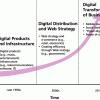


The goal of this Executive Report is to present six digital-driven transformations affecting 21st-century organizations. These are neither technologies nor business models per se; rather, they are transformations that define the connecting tissue between digital technologies and business strategies.
The purpose of the accompanying Executive Report is to define the nature and impact of "digital transformations" in the eyes, minds, and hands of CIOs and other CxO leaders: "eyes" in the sense of recognizing six concrete transformations; "minds" in the sense of understanding the meaning of these transformations for the organizations; and "hands" in the sense of driving some actions.
Much has been said about innovation. The argument is twofold: