


Business Transformation Requires Transformational Leaders
Leadership and teaming skills are front and center in times of rapid change. Meet today’s constant disruption head on with expert guidance in leadership, business strategy, transformation, and innovation. Whether the disruption du jour is a digitally-driven upending of traditional business models, the pandemic-driven end to business as usual, or the change-driven challenge of staffing that meets your transformation plans — you’ll be prepared with cutting edge techniques and expert knowledge that enable strategic leadership.
Subscribe to Arthur D. Little's Culture & Leadership Newsletter
Insight

Although some may argue that IT's capacity to contribute to business competitiveness has faded, we suggest instead that it has evolved and expanded, maturing and changing within a subset of companies that have effectively managed to use IT in various ways. In this two-part Executive Report series, we examine the status of the use of IT to improve organizational capabilities and promote business value, identifying varieties of use and directional trends as well as managerial challenges and critical success factors through five case studies.
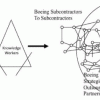
Although some may argue that IT's capacity to contribute to business competitiveness has faded, we suggest instead that it has evolved and expanded, maturing and changing within a subset of companies that have effectively managed to use IT in various ways. In this two-part Executive Report series, we examine the status of the use of IT to improve organizational capabilities and promote business value, identifying varieties of use and directional trends as well as managerial challenges and critical success factors through five case studies. Here in Part I, we explore the first two: the Boeing 787 and JPMorgan Chase.
Although some may argue that IT's capacity to contribute to business competitiveness has faded, we suggest instead that it has evolved and expanded, maturing and changing within a subset of companies that have effectively managed to use IT in various ways. In this two-part Executive Report series, we examine the status of the use of IT to improve organizational capabilities and promote business value, identifying varieties of use and directional trends as well as managerial challenges and critical success factors through five case studies.

Executive Update
Log Analysis for SLA Management





Leadership Is an Art
Leadership is a phenomenon that is hard to describe or quantify. Like musical talent or athletic ability, leadership is innate -- some have it, some don't.