

Business Transformation Requires Transformational Leaders
Leadership and teaming skills are front and center in times of rapid change. Meet today’s constant disruption head on with expert guidance in leadership, business strategy, transformation, and innovation. Whether the disruption du jour is a digitally-driven upending of traditional business models, the pandemic-driven end to business as usual, or the change-driven challenge of staffing that meets your transformation plans — you’ll be prepared with cutting edge techniques and expert knowledge that enable strategic leadership.
Subscribe to Arthur D. Little's Culture & Leadership Newsletter
Insight
By capitalizing on Internet-enabled technology, organizations have increased visibility and interactivity with their customers through the implementation of CRM systems, which have helped organizations streamline transactions, learn about customer preferences, and boost relationships.
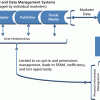
The face of marketing is changing, forever, and it's important for all marketers to be aware of the trends behind this change so that they are prepared to engage consumers in the future. Over the last few decades, both large and small companies throughout nearly all industries have learned to survive and thrive on the collection, aggregation, analysis, ownership, and use of consumer information in order to develop profiles of each and every individual they interact with or want to.

In this issue, we've turned our attention to a topic of perpetual importance: the relationship we have with our customers and the means by which we manage and derive value from our interactions with them. The new thing here is the emergence of customer-managed interactions (CMI), which is receiving substantial push and gaining momentum due to the increasing technology savvy of consumers. CMI is the revolutionary next step — and perhaps the future coexisting first cousin — to the well-established CRM.
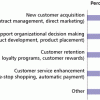

This survey examined how well organizations are equipped to work with the new reality in which consumers have some degree of control over the increasing amounts of personal information they provide online, including with whom they share that information. Nearly half (44%) of the 32 responding organizations are headquartered or based in North America, with 19% in Europe, 19% in Australia/Pacific, 9% in Africa, 6% in Asia, and 3% in the Middle East.

Old Wine in a New Bottle
The value chain concept dates to 1985, so if it was able to ground business-IT discussions in a rational assessment of IT's contribution to value generation, we'd know it by now. The revival of this notion among architects is going to make IT sound as if they care about business concepts, but the only sure benefit will be to consulting firms' revenues.


