Business Transformation Requires Transformational Leaders
Leadership and teaming skills are front and center in times of rapid change. Meet today’s constant disruption head on with expert guidance in leadership, business strategy, transformation, and innovation. Whether the disruption du jour is a digitally-driven upending of traditional business models, the pandemic-driven end to business as usual, or the change-driven challenge of staffing that meets your transformation plans — you’ll be prepared with cutting edge techniques and expert knowledge that enable strategic leadership.
Subscribe to Arthur D. Little's Culture & Leadership Newsletter
Insight

In these five years of charting IT budgets and the budgeting process, we have documented the roller-coaster ride that IT shops around the globe have been on as things went from good times to perhaps the greatest economic crisis ever to strike the global economy to now slowly and gingerly climbing back out of the recession. Because we have been able to keep our team of experts intact and to maintain the core set of survey questions we ask of the respondents, we have learned quite a bit about the manner in which modern organizations react (and should react) to these kinds of events. We have learned, for example that the knee-jerk reaction typical of past crises whereby the firm would slash IT budgets seeking to "trim the fat" and "reduce overhead" wasn't exactly the case. In last year's survey, we found that "while organizations are indeed cutting projects and limiting their exposure by reducing investments in IT, they are also limiting reductions in the IT shop as much as possible knowing that IT assets and knowledge lost during a downturn cannot be readily rebuilt and scaled once the economy turns. As a consequence, the shape that this downturn has been taking for IT and IT professionals is likely different than the historical pattern of deep cost-cutting measures."


In these five years of charting IT budgets and the budgeting process, we have documented the roller-coaster ride that IT shops around the globe have been on as things went from good times to perhaps the greatest economic crisis ever to strike the global economy to now slowly and gingerly climbing back out of the recession. Because we have been able to keep our team of experts intact and to maintain the core set of survey questions we ask of the respondents, we have learned quite a bit about the manner in which modern organizations react (and should react) to these kinds of events. We have learned, for example that the knee-jerk reaction typical of past crises whereby the firm would slash IT budgets seeking to "trim the fat" and "reduce overhead" wasn't exactly the case. In last year's survey, we found that "while organizations are indeed cutting projects and limiting their exposure by reducing investments in IT, they are also limiting reductions in the IT shop as much as possible knowing that IT assets and knowledge lost during a downturn cannot be readily rebuilt and scaled once the economy turns. As a consequence, the shape that this downturn has been taking for IT and IT professionals is likely different than the historical pattern of deep cost-cutting measures."
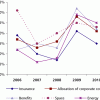

In these five years of charting IT budgets and the budgeting process, we have documented the roller-coaster ride that IT shops around the globe have been on as things went from good times to perhaps the greatest economic crisis ever to strike the global economy to now slowly and gingerly climbing back out of the recession. Because we have been able to keep our team of experts intact and to maintain the core set of survey questions we ask of the respondents, we have learned quite a bit about the manner in which modern organizations react (and should react) to these kinds of events. We have learned, for example that the knee-jerk reaction typical of past crises whereby the firm would slash IT budgets seeking to "trim the fat" and "reduce overhead" wasn't exactly the case. In last year's survey, we found that "while organizations are indeed cutting projects and limiting their exposure by reducing investments in IT, they are also limiting reductions in the IT shop as much as possible knowing that IT assets and knowledge lost during a downturn cannot be readily rebuilt and scaled once the economy turns. As a consequence, the shape that this downturn has been taking for IT and IT professionals is likely different than the historical pattern of deep cost-cutting measures."
In these five years of charting IT budgets and the budgeting process, we have documented the roller-coaster ride that IT shops around the globe have been on as things went from good times to perhaps the greatest economic crisis ever to strike the global economy to now slowly and gingerly climbing back out of the recession. Because we have been able to keep our team of experts intact and to maintain the core set of survey questions we ask of the respondents, we have learned quite a bit about the manner in which modern organizations react (and should react) to these kinds of events. We have learned, for example that the knee-jerk reaction typical of past crises whereby the firm would slash IT budgets seeking to "trim the fat" and "reduce overhead" wasn't exactly the case. In last year's survey, we found that "while organizations are indeed cutting projects and limiting their exposure by reducing investments in IT, they are also limiting reductions in the IT shop as much as possible knowing that IT assets and knowledge lost during a downturn cannot be readily rebuilt and scaled once the economy turns. As a consequence, the shape that this downturn has been taking for IT and IT professionals is likely different than the historical pattern of deep cost-cutting measures."
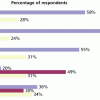

In these five years of charting IT budgets and the budgeting process, we have documented the roller-coaster ride that IT shops around the globe have been on as things went from good times to perhaps the greatest economic crisis ever to strike the global economy to now slowly and gingerly climbing back out of the recession. Because we have been able to keep our team of experts intact and to maintain the core set of survey questions we ask of the respondents, we have learned quite a bit about the manner in which modern organizations react (and should react) to these kinds of events. We have learned, for example that the knee-jerk reaction typical of past crises whereby the firm would slash IT budgets seeking to "trim the fat" and "reduce overhead" wasn't exactly the case. In last year's survey, we found that "while organizations are indeed cutting projects and limiting their exposure by reducing investments in IT, they are also limiting reductions in the IT shop as much as possible knowing that IT assets and knowledge lost during a downturn cannot be readily rebuilt and scaled once the economy turns. As a consequence, the shape that this downturn has been taking for IT and IT professionals is likely different than the historical pattern of deep cost-cutting measures."