Business Transformation Requires Transformational Leaders
Leadership and teaming skills are front and center in times of rapid change. Meet today’s constant disruption head on with expert guidance in leadership, business strategy, transformation, and innovation. Whether the disruption du jour is a digitally-driven upending of traditional business models, the pandemic-driven end to business as usual, or the change-driven challenge of staffing that meets your transformation plans — you’ll be prepared with cutting edge techniques and expert knowledge that enable strategic leadership.
Subscribe to Arthur D. Little's Culture & Leadership Newsletter
Insight
No other target of investment is likely to generate higher returns than innovation.1 While this isn't news for many companies, the fact that a growing number use performance measures to manage innovation should be of interest to those who don't.


No other target of investment is likely to generate higher returns than innovation.1 While this isn't news for many companies, the fact that a growing number use performance measures to manage innovation should be of interest to those who don't.
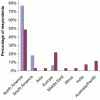


For Cutter Benchmark Review (CBR), Cutter Consortium has conducted three annual worldwide surveys about IT budget practices, and, in 2008, conducted a worldwide survey about dynamic IT and the impact of IT governance on the ability of companies to be dynamic.1 The participants were global in scope (about half from North America with the remaining from other parts of the world).


Concerns over a recession are affecting business and IT organizations globally -- private and public sectors alike. A number of economists and industry analysts submit that most companies need to realign their business and IT strategies to maintain a balanced state of operations for the next couple of years.


Organizations today are in the throes of profound change fostered by technical evolution and economic crisis. One of the most significant is the continued growth in collaboration within the company and with the supply chain -- and even with customers. The importance of collaboration has grown steadily since the 1970s, with significant additional impetus applied by digitization.


Back in early January, I said that the most important BI-related initiative for organizations in 2009 would be business performance management (see "Business Performance Management Tops '09 Strategy List," 6 January 2009). In fact, I recommended that you consider business performance management a strategic application.