


Business Transformation Requires Transformational Leaders
Leadership and teaming skills are front and center in times of rapid change. Meet today’s constant disruption head on with expert guidance in leadership, business strategy, transformation, and innovation. Whether the disruption du jour is a digitally-driven upending of traditional business models, the pandemic-driven end to business as usual, or the change-driven challenge of staffing that meets your transformation plans — you’ll be prepared with cutting edge techniques and expert knowledge that enable strategic leadership.
Subscribe to Arthur D. Little's Culture & Leadership Newsletter
Insight


In the first three parts of this Executive Update series 1 about Cutter's annual survey on innovation practices, we described the enterprise innovation chain (value innovation, management innovation, business model innovation, and invention), identified key findings of the research, and presented additional detailed characteristics of organizations that assess themselves as successful innovators.
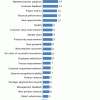
In the first three parts of this Executive Update series 1 about Cutter's annual survey on innovation practices, we described the enterprise innovation chain (value innovation, management innovation, business model innovation, and invention), identified key findings of the research, and presented additional detailed characteristics of organizations that assess themselves as successful innovators.
Executive Update
IT Services Sourcing: Business vs. Technological Decision
Performing some IT and communications tasks through internal or external means is not a technological decision; in fact, it is one that focuses on business, and it needs to be framed within the company's general organizational strategy. The reasons that a CIO confronts this dilemma can vary, but they usually involve company pressure to reduce costs, concern for fighting hardware obsolescence, and an intention to reduce the organizational structure. However, there is much more.


The first part of my analysis of this year's IT trends data from a recent Cutter survey1 focuses on the labor within the IT organization, specifically issues associated with outsourcing and with staffing levels. We posed a general question to our respondents asking them to describe their current IT staffing situation.

Over the past few months, Cutter Senior Consultant Jeff Kaplan has been analyzing the results of our 4th annual survey on charting the growth of the software-as-a-service market. This year, the data has uncovered a new round of important market trends that have implications to IT and business decision makers.


In last week's Advisor, I wrote that the most demanding task confronting organizations in their business performance management initiatives is identifying and implementing the key performance indicators (KPIs) and metrics needed to measure and manage operational performance in relation to strategies and goals (see, "Six Key Roadblocks En Ro


I am sitting here, sipping my free cup of coffee at McDonald's, looking across the parking lot at the huge going-out-of-business banners strung across the entrance to my local Circuit City store.
"I wonder," I said, joking with the McDonald's manager, who I know pretty well, "if they had to pay for those banners up front and in cash?"
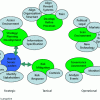
Value-based governance enables leaders to define the value of the business and inject those values into the governance structure that defines how players in the organization conduct themselves. Institutionalizing business governance at each level of the organization is daunting when considering the complexities of increasingly global and virtual work environments. Standardizing business governance in business operations requires more than documenting and training employees on corporate code-of-conduct requirements.