


Business Transformation Requires Transformational Leaders
Leadership and teaming skills are front and center in times of rapid change. Meet today’s constant disruption head on with expert guidance in leadership, business strategy, transformation, and innovation. Whether the disruption du jour is a digitally-driven upending of traditional business models, the pandemic-driven end to business as usual, or the change-driven challenge of staffing that meets your transformation plans — you’ll be prepared with cutting edge techniques and expert knowledge that enable strategic leadership.
Subscribe to Arthur D. Little's Culture & Leadership Newsletter
Insight

Domain
Market mechanisms
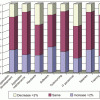
Here, in the last in a three-part series, we examine the detailed IT spending plans for 2004 of 97 organizations. At the time of the survey (July 2003), "IT intensity" (IT spending as a percentage of total organizational spending) was expected to remain approximately flat in 2004. This masked a great deal of variation, with approximately one-third of the organizations reducing their spending, one-third increasing, and one-third staying about the same.
Executive Update
Aligning IT Training Strategies with ROI
As a result of tough economic conditions over the past few years, IT budgets have been exposed to intense scrutiny. They have become subject to solid business metrics such as earned value and return on investment (ROI). As a result, new trends are emerging concerning the perception of IT training within the workplace.
Executive Update
The Role of IT in Leveraging Pricing to Boost Profits
Executive Update
The Sarbanes-Oxley Act: Implications for the CIO
The Sarbanes-Oxley Act is the US federal government's reaction to the corporate debacles of Enron, WorldCom, Adelphia, and several other companies. The law requires specific financial reporting by public companies, with severe penalties for willful misrepresentation of financial results or forecasts.


What were the biggest developments in agile software development and project management in 2003? And what lies ahead in 2004? We posed these questions to three Cutter Consortium Senior Consultants: Scott W. Ambler, E.M. Bennatan, and Robert N. Charette.