



Strategic advice to leverage new technologies
Technology is at the heart of nearly every enterprise, enabling new business models and strategies, and serving as the catalyst to industry convergence. Leveraging the right technology can improve business outcomes, providing intelligence and insights that help you make more informed and accurate decisions. From finding patterns in data through data science, to curating relevant insights with data analytics, to the predictive abilities and innumerable applications of AI, to solving challenging business problems with ML, NLP, and knowledge graphs, technology has brought decision-making to a more intelligent level. Keep pace with the technology trends, opportunities, applications, and real-world use cases that will move your organization closer to its transformation and business goals.
Insight
The Internet of Things (IoT) is going to have a tremendous impact on environmental protection. This will come about from end-user companies, researchers, the media, environmental watchdog groups, and even ordinary citizens using wireless sensors, video cameras, and drones for real-time environmental monitoring, pollution control, and facilities management and maintenance.
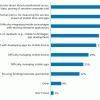
This Executive Update -- Part III of a series -- focuses on survey findings pertaining to mobile application development trends and the issues confronting organizations with implementing their initiatives, including primary obstacles and issues affecting corporate mobility adoption/implementation efforts, mobile application development trends, corporate use of mobile device management platforms, and corporate use of enterprise app stores.



A software project can, of course, be characterized by various parameters. We recommend starting with the (elusively) simple question of the intrinsic nature of the project.
Manufacturing and process industries are making extensive use of sensors, mobile, and other Internet of Things (IoT) technologies to connect, monitor, and measure equipment, vehicles, material, and processes. This trend is starting to accelerate and is expected to continue doing so for the foreseeable future.
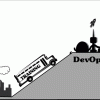

DevOps requires greater communication and coordination between development and operations in order to facilitate the rapid releases of working software. It is based around principles that have become well established in Agile development and are accelerating with mobility. Apps need to be developed and deployed rapidly, updated regularly, and they have to respond immediately to user demands. The need for apps to integrate with existing enterprise software is pushing DevOps ideas deeper into the development environment.


If we use measures properly, we do so to improve our business, organization, or our lives. In this respect, there are many times when having some data is not better than having none.

Essentially, business activity monitoring (BAM) data, which is collected and produced by a business process management (BPM)-type application, is just another subset of BI within the organization. BAM data may be pushed to a big data repository, but a BAM repository should never be used for big data analysis. BAM environments are characterized by online, real-time users, where throughput and performance are paramount. BAM queries and reports should be targeted to simple operational status views against optimized, normalized tables.

DevOps is more than a set of tools and scripts used to make software operations easier within a software engineering group. DevOps is also a set of principles based on the belief that when an organization improves its deployment frequency, it will find success with a faster time to market, a lower failure rate on new releases, a shorter time between reporting bugs and deploying fixes in production, and a heightened ability to respond to production operations issues. Increased deployment frequency leads to increased profitability due to these successes. As we explore in this Executive Update, when an organization begins an internal DevOps initiative, it will find that it needs architectural changes for its desires to come to fruition.