



Strategic advice to leverage new technologies
Technology is at the heart of nearly every enterprise, enabling new business models and strategies, and serving as the catalyst to industry convergence. Leveraging the right technology can improve business outcomes, providing intelligence and insights that help you make more informed and accurate decisions. From finding patterns in data through data science, to curating relevant insights with data analytics, to the predictive abilities and innumerable applications of AI, to solving challenging business problems with ML, NLP, and knowledge graphs, technology has brought decision-making to a more intelligent level. Keep pace with the technology trends, opportunities, applications, and real-world use cases that will move your organization closer to its transformation and business goals.
Insight
Social media is touted increasingly as an important source for identifying key indicators pertaining to consumer sentiment, product/brand preferences, market volatility, buying habits, and other trends that organizations can apply in their efforts to understand and influence consumer purchasing, opinion, and other behaviors.


"Agile" has become a big word these days. In the context of this issue of Cutter IT Journal, we are referring to the practice of satisfying our customers "through early and continuous delivery of valuable software."1 DW/BI teams that embrace an Agile approach work on the requirements that provide the most business value first. They ensure they are building the right things through regular customer reviews and short learning cycles and by working together as cross-functional, collaborative, and self-organizing teams. Not a client? Download your complimentary copy here.
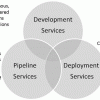

In the end, the success or failure of your implementation of Agile data warehousing at scale starts and ends with your leadership. Leaders with a unquenchable thirst for knowledge combined with a kaizen mindset have a distinct advantage when it comes to putting theory into practice. As a leader, you must carve time out of your hectic schedule to learn about both the methodologies you aspire to use and the system in which your organization operates. Not a client? Download your complimentary copy here.
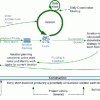

Data warehousing/business intelligence (DW/BI) development is one of the few "final frontiers" remaining for wide-scale adoption of Agile solution delivery strategies. Several people have led the way in applying Agile techniques in the DW/BI field,1-3 but their advice is just now being adopted by mainstream data practitioners. Having said that, I believe we are quickly reaching a tipping point where Agile strategies will become mainstream within the data community. This article overviews the strategies and techniques that a disciplined Agile DW/BI team will follow. Not a client? Download your complimentary copy here.
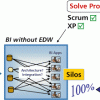

The Extreme ScopingTM method presented in this article is such a Data-Agile approach. It is designed to apply most Agile principles to a robust soup-to-nuts spiral data integration methodology that includes all the data management activities so crucial for enterprise-class data integration projects. Not a client? Download your complimentary copy here.
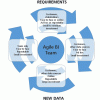

There are tools that can help BI professionals make the right moves, and make the results stick. A growing collection of serious games -- the application of game-like activities to business, education, politics, and other "serious" settings -- provide direct benefits to BI projects. They already mesh well with Agile development practices, making their application in Agile BI projects that much easier. Not a client? Download your complimentary copy here.
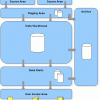
This article recommends a number of techniques and best practices that retain the benefits of a central data warehouse while reducing the expense and lack of responsiveness to business needs and change. This data-focused approach offers a way to define user stories in a complex data warehouse architecture, addressing both application and information value to users and delivering a data warehouse that provides high-quality information and is resilient to change. Not a client? Download your complimentary copy here.
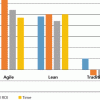
Despite advances in tools, technologies, and practices, a large percentage of DW/BI projects continue to fail, and project managers are looking for critical advice. Agile is clearly one remedy for raising the success rate of DW/BI projects. Not a client? Download your complimentary copy here.