Strategic advice to leverage new technologies
Technology is at the heart of nearly every enterprise, enabling new business models and strategies, and serving as the catalyst to industry convergence. Leveraging the right technology can improve business outcomes, providing intelligence and insights that help you make more informed and accurate decisions. From finding patterns in data through data science, to curating relevant insights with data analytics, to the predictive abilities and innumerable applications of AI, to solving challenging business problems with ML, NLP, and knowledge graphs, technology has brought decision-making to a more intelligent level. Keep pace with the technology trends, opportunities, applications, and real-world use cases that will move your organization closer to its transformation and business goals.
Insight
If one combines mobile consumer technology with Big Data analytics, one gets a host of new possibilities ranging from new ways of providing students with basic support to new ways of getting students to learn what the faculty needs them to learn. If we can get the right information flowing through the minds of students, perhaps we can improve their success. We can potentially help transform the classroom from the 19th century to the 21st.






As we move into the era of Big Data analysis and extensive use of unstructured data, it is time to take a closer look at data-quality issues. While there have long been procedures in place for ensuring quality of transactional data, unstructured data has been less well served. Unstructured data and data sources outside of the firm can be relatively opaque. Processes should be developed to ensure that data is maintained for future use -- adequately stored, accurate, and secure.



"If you want to create an Agile organization, you can't rely on stacking the deck with your best staff members -- everyone needs to make the transition, not just your star players."
-- Scott W. Ambler, Guest Editor
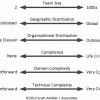

Although many Agile teams are small, say 10 or fewer people, and either colocated or at least near-located, the majority of Agile teams work in more complex situations. For example, some teams are several dozen people in size and sometimes larger. Some teams are geographically distributed. Some are taking on very challenging problems.