



Strategic advice to leverage new technologies
Technology is at the heart of nearly every enterprise, enabling new business models and strategies, and serving as the catalyst to industry convergence. Leveraging the right technology can improve business outcomes, providing intelligence and insights that help you make more informed and accurate decisions. From finding patterns in data through data science, to curating relevant insights with data analytics, to the predictive abilities and innumerable applications of AI, to solving challenging business problems with ML, NLP, and knowledge graphs, technology has brought decision-making to a more intelligent level. Keep pace with the technology trends, opportunities, applications, and real-world use cases that will move your organization closer to its transformation and business goals.
Insight
I've been saying for some time now that in order for Hadoop to really make it in the mainstream enterprise, it needed to provide better support for traditional SQL-based data management and analysis tools and offer the kind of interactive functionality that business users have come to expect from their BI environments.







In recent Advisors I have explored the differences between product and project thinking in software development and the importance of long-term thinking to sustain an economically successful software system (see "On Projects, Products, and Gaming Theory" and "Software As an Asset").
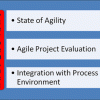

While there have been numerous attempts to develop Agile metrics through the years, it remains a difficult issue as we explore in this Executive Update. This is as much due to the "rules" of agility as it is to the nature of Agile processes themselves.

Business architecture helps portfolio managers prioritize IT-based projects by mapping projects to a business capability architecture (BCA). A BCA can aggregate what's important, urgent, and doable in an organization, and this aggregation can then be used to prioritize projects.

Several weeks ago, I discussed how collaboration by Silicon Valley tech companies with the US National Security Agency (NSA) in its data gathering program (i.e., "Prism") could pose problems for US-based cloud companies (see "US Cloud Companies and the NSA's Data Col