


Strategic advice to leverage new technologies
Technology is at the heart of nearly every enterprise, enabling new business models and strategies, and serving as the catalyst to industry convergence. Leveraging the right technology can improve business outcomes, providing intelligence and insights that help you make more informed and accurate decisions. From finding patterns in data through data science, to curating relevant insights with data analytics, to the predictive abilities and innumerable applications of AI, to solving challenging business problems with ML, NLP, and knowledge graphs, technology has brought decision-making to a more intelligent level. Keep pace with the technology trends, opportunities, applications, and real-world use cases that will move your organization closer to its transformation and business goals.
Insight
There is an increasing realization that EA cannot work in technological isolation but must work collaboratively as a capability within the culture of the organization. The EA team should act as one -- albeit key -- cog in the organizational engine with the overall goal of improving the effectiveness of the business itself.
Executive Update
Why Are EA Departments Having Such a Hard Time with Business Units?
Corporate enterprise architecture (EA) departments often have a hard time dealing with business units (BUs), even if it is clear that there are benefits in a centralized architecture and common solutions. BUs, pursuing their own targets, don't want to be bothered by central rules because these are perceived as restrictive in doing business.
For any central guidance to succeed, two conditions are important:

With this month's CBR we crafted one such issue on a topic that is losing some of the buzz surrounding it -- and for that very reason may be moving into its most productive phase! Let me take a tangent here. Have you ever noticed how there are largely two broad sets of people: those who talk and those who do? OK, that may be an oversimplification (how uncharacteristic for an academic you may say), as there are plenty of variations between these two extremes, but go with me here for a minute. I'm sure you remember the many people you have met in your life who have told you how good they are, how much they have achieved, how close they were to getting that new position, and so on. Very often this façade of certainty and bravado hides a relatively thin record of real accomplishments; conversely, there is a broad group of extremely accomplished people who let the facts speak for themselves.

Article
Web 2.0: Untapped Opportunities
The participants for this 2010 Web 2.0 survey were asked the same questions as in the 2007 study, with one exception.
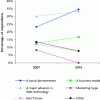

This survey examined current views on Web 2.0 and its importance to the enterprise. The geographic distribution of the 78 respondents is worldwide, with 47% of respondents' organizations based in North America, 28% in Europe, 10% in Asia, 8% in Australia/Pacific, and the rest in other parts of the world.

Abstract
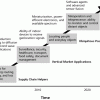
The overall mission of operational and business intelligence (BI) is to make sense of and to strategically leverage data and information, much of which can be unstructured. In the near future, thanks to the proliferation of sensor-based information networks, the typical opportunities and challenges linked to knowledge mining will intensify.