


Strategic advice to leverage new technologies
Technology is at the heart of nearly every enterprise, enabling new business models and strategies, and serving as the catalyst to industry convergence. Leveraging the right technology can improve business outcomes, providing intelligence and insights that help you make more informed and accurate decisions. From finding patterns in data through data science, to curating relevant insights with data analytics, to the predictive abilities and innumerable applications of AI, to solving challenging business problems with ML, NLP, and knowledge graphs, technology has brought decision-making to a more intelligent level. Keep pace with the technology trends, opportunities, applications, and real-world use cases that will move your organization closer to its transformation and business goals.
Insight
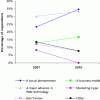

This survey examined current views on Web 2.0 and its importance to the enterprise. The geographic distribution of the 78 respondents is worldwide, with 47% of respondents' organizations based in North America, 28% in Europe, 10% in Asia, 8% in Australia/Pacific, and the rest in other parts of the world.
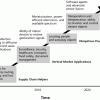

Abstract
The overall mission of operational and business intelligence (BI) is to make sense of and to strategically leverage data and information, much of which can be unstructured. In the near future, thanks to the proliferation of sensor-based information networks, the typical opportunities and challenges linked to knowledge mining will intensify.


In my last Advisor (see "How The Checklist Manifesto Breaks Down Problems," 10 February 2010), I recommended the book The Checklist Manifesto -- How to Get Things Right by Atul Gawande and promised to draw some parallels


I've noticed a growing interest by end-user organizations in using data mining technology -- particularly for predictive customer analytics. Several trends account for this. First, organizations now find themselves with so much data that they are looking for ways to capitalize on this valuable resource.


In this series of Advisors, I'm exploring some typical problems traditionally trained managers run into when their organization starts to use agile (see "Hidden Pitfalls of Agile: Self-Organization," 14 January 2010, "Hidden Pitfalls of Agile: User Contact


The current economy has made enterprise architecture (EA) more significant for the IT industry than ever before. Most organizations have been forced to accept the enterprise-level transformational capabilities and associated impacts of EA as practice -- and plan to leverage its functions both in strategic and tactical ways.

Informatica Corporation has made several recent announcements pertaining to cloud data integration. These include the Informatica Cloud 9 data integration platform, specific cloud services for data integration, and on-demand data quality and address-correction tools and services -- including data quality software for use on Amazon's Elastic Compute Cloud (EC2) platform.