

Strategic advice to leverage new technologies
Technology is at the heart of nearly every enterprise, enabling new business models and strategies, and serving as the catalyst to industry convergence. Leveraging the right technology can improve business outcomes, providing intelligence and insights that help you make more informed and accurate decisions. From finding patterns in data through data science, to curating relevant insights with data analytics, to the predictive abilities and innumerable applications of AI, to solving challenging business problems with ML, NLP, and knowledge graphs, technology has brought decision-making to a more intelligent level. Keep pace with the technology trends, opportunities, applications, and real-world use cases that will move your organization closer to its transformation and business goals.
Insight
Occasionally, I will ask my students, "Why is the Roman Coliseum still standing?" The answer that I'm fishing for is, "Because the folks who tried to tear it down in the Middle Ages for building material were not as good engineers as the folks who put it up hundreds of years earlier." All this was recently brought to mind because I've been reading a series of historical novels set in 9th centu


Several weeks ago when I issued my predictions for the coming year, I said that I expected that the use of software and services for analyzing social networking/media sites such as Facebook, Twitter, YouTube, LinkedIn, and Yelp, would begin to increase in 2010 (see "BI and Data Warehousing Predictions for 2010," 22 December 2009).

Abstract
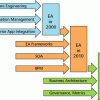
Enterprise architecture (EA) can be traced back to 1987 and has continually evolved ever since. In this Executive Report by Claude R.
Executive Report
How Not to Run an IT Project: A Case Study
Abstract
The reasons for, and statistics on, IT project failures are well known and cited. However, because so many organizations attempt to hide their dirty laundry, rarely do we see an insider's account of the precise points at which a project derailed.
Executive Summary
How Not to Run an IT Project: A Case Study
In March 2009, a major hospital system -- which we will call NEP -- began a multimillion-dollar IT project. The objective: to replace its hodgepodge of legacy back-office systems with one integrated enterprise resource planning (ERP) solution and a single database housing all enterprise information.