


Strategic advice to leverage new technologies
Technology is at the heart of nearly every enterprise, enabling new business models and strategies, and serving as the catalyst to industry convergence. Leveraging the right technology can improve business outcomes, providing intelligence and insights that help you make more informed and accurate decisions. From finding patterns in data through data science, to curating relevant insights with data analytics, to the predictive abilities and innumerable applications of AI, to solving challenging business problems with ML, NLP, and knowledge graphs, technology has brought decision-making to a more intelligent level. Keep pace with the technology trends, opportunities, applications, and real-world use cases that will move your organization closer to its transformation and business goals.
Insight
Enterprise adoption of social media usually hinges on three factors: financial projections, pilot results, and politics. Financial projections are based on spreadsheet models. Pilot efforts, often called proof-of-concept efforts, study the real-life effects of the innovation. But the effort involves resource allocation, and that's where politics enters.
Executive Update
The Ontology of Intelligent Agents
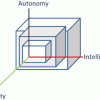
The term "agent" is used as an anthropomorphic metaphor. Such figures of speech serve a purpose in that they are beneficial for human-machine interaction and for developing high-level abstractions of information structures. The metaphor "agent" has a social origin (e.g., travel agent). It falls in line with the emergence of the Internet as a social phenomenon. The Internet houses an enormous number of autonomous individuals and entities with varying degrees of intelligence and autonomy interacting with one another.


Cloud computing is another iteration of a trend that began 40-plus years ago. In the beginning of the computer age, only large, wealthy enterprises and governments had computers. Early mainframe computers were huge power hogs and, by modern standards, impossibly slow; but for large numbers of tasks, they were much faster and economical than the way organizations were doing business.


I have been talking with friends and colleagues about how data integration requirements and ensuring data integrity can pose problems for organizations implementing business performance management initiatives. I found this discussion so interesting that I decided to use the topic for this week's Advisor.


Imagine going to the office in the morning, switching the computer on, and finding updates on your desktop that summarize what coworkers and colleagues in your organization and in your wider professional network have been up to. When someone in your network makes a change or uploads or downloads a file that is relevant to you, you'll be notified.




As an EA and SOA consultant and authority, I get a lot of questions about architecture, its value, how to implement it, and how to roll it out to an organization. Occasionally (like last week), the questions are so off base that they amaze me. Are managers really this out of touch (no need to answer that)?

Enterprise data warehousing specialist Teradata Corporation is the latest analytics database vendor to join the cloud movement. Last week, Teradata introduced its first product offerings targeted at organizations wanting to take advantage of virtualization and cloud technologies for data warehousing and BI applications.