


Strategic advice to leverage new technologies
Technology is at the heart of nearly every enterprise, enabling new business models and strategies, and serving as the catalyst to industry convergence. Leveraging the right technology can improve business outcomes, providing intelligence and insights that help you make more informed and accurate decisions. From finding patterns in data through data science, to curating relevant insights with data analytics, to the predictive abilities and innumerable applications of AI, to solving challenging business problems with ML, NLP, and knowledge graphs, technology has brought decision-making to a more intelligent level. Keep pace with the technology trends, opportunities, applications, and real-world use cases that will move your organization closer to its transformation and business goals.
Insight
EA Is Catching Up with Reality
Enterprise architecture is finally becoming a mature, mainstream activity in large organizations. This includes controlling complexity and aligning to the business in light of current realities such as outsourcing.
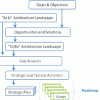

There are long-standing enterprise architecture (EA) frameworks that are very complete and ready to be leveraged. However, a focus on technology and frameworks can undermine an EA effort. To successfully develop and mature an EA practice, it takes principles and action plans coupled with collaboration, engagement, and leadership.

Recession? TCS, Infosys, Wipro, HCL Bag Large Outsourcing Deals.
-- Economic Times
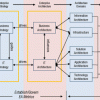

Enterprise architecture (EA) plays an important role in delivering the business value for any large or complex enterprise. In practice, however, the real business value of EA is still not recognized to its full extent in some cases.
THE COMING OF CLOUD COMPUTING
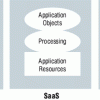
Cloud computing is a paradigm shift to a new form of enterprise distributed computing that takes place outside of the cloud consumer's computing environments. In cloud computing, everything is considered a service, including software services, the application development platform, and infrastructure supports. Cloud computing presents a range of simplified, flexible, and convenient service choices to enterprises.
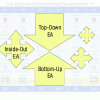

Enterprise architecture (EA) practices1 have evolved and matured significantly over the past two decades. However, EA as a discipline continues to be largely misunderstood by management, who questions its value, and EA initiatives still often fail to achieve actionable outcomes.
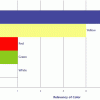
This Executive Update takes the thinking presented in my last Update ("Enterprise Architects and Organizational Change: A Requirement or an Option?")1 one step further and looks at the requirements for different types of architects in terms of five colors, each representing a perspective that aims to bring change to an organization.
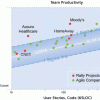


The phenomenon of open source software (OSS) is a recognized and mature aspect of the global IT market with profound implications for enterprise IT. A newer trend emerging is the various disciplines and methodologies that fall under the rubric of agile software development, which has a number of interesting parallels with and similarities to OSS.