

Strategic advice to leverage new technologies
Technology is at the heart of nearly every enterprise, enabling new business models and strategies, and serving as the catalyst to industry convergence. Leveraging the right technology can improve business outcomes, providing intelligence and insights that help you make more informed and accurate decisions. From finding patterns in data through data science, to curating relevant insights with data analytics, to the predictive abilities and innumerable applications of AI, to solving challenging business problems with ML, NLP, and knowledge graphs, technology has brought decision-making to a more intelligent level. Keep pace with the technology trends, opportunities, applications, and real-world use cases that will move your organization closer to its transformation and business goals.
Insight
Executive Update
Systems Breakdown Case Study: A Square Peg and a Round Hole
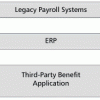
Every organization uses software applications to support its business processes. Some organizations buy, some build, and some rent software as a service (SaaS). Buying and integrating proprietary applications are sometimes complicated by M&A activity; acquired or merged organizations often use different applications and systems than their new owners. CIOs facing this type of problem should think long and hard when considering integrating disparate applications.


In today's tight economic environment, business executives may well see "the cloud" as the answer to their cost-cutting prayers. Bloated and unproductive EA initiatives are rightly going to receive short shrift in this climate -- eclipsed behind the cloud, if you'll pardon the metaphor. How can EA get both leaner and meaner while remaining relevant to the business agenda?



In recent years, many agile software development teams have used a Planning Poker practice to estimate the effort needed to complete the features chosen to be implemented in an iteration and/or release. Planning Poker is "played" by the team as a part of the iteration planning meeting, which is attended by product managers, project managers, software developers, testers, usability engineers, security engineers, and others.


Is your perimeter secure? The answer to that is simple: NO. As business has become more distributed, outsourcing has gone global, supply chains are more connected, employees have become teleworkers, customers demand better information, and so on, we have systematically punched holes into perimeter security until it now resembles Swiss cheese.

Data warehousing database vendor Greenplum has launched what the company calls its "Enterprise Data Cloud" (EDC) initiative. EDC builds on Greenplum's flagship massively parallel data warehousing database -- optimized for analytics and dynamic scalability -- and the concept of self-service provisioning.


The capabilities delivered by BI technologies, which provide computational power, speed, and capacity, do not always address and resolve the issues derived from the lack of interoperability of disparate data sets.

One of the greatest strengths of agile methodologies is that exploratory techniques involving collaboration between people -- the very fabric of software development -- take center stage. At the same time, from a service-oriented point of view, rigor is needed in specifying services and the components used to implement them.