



Strategic advice to leverage new technologies
Technology is at the heart of nearly every enterprise, enabling new business models and strategies, and serving as the catalyst to industry convergence. Leveraging the right technology can improve business outcomes, providing intelligence and insights that help you make more informed and accurate decisions. From finding patterns in data through data science, to curating relevant insights with data analytics, to the predictive abilities and innumerable applications of AI, to solving challenging business problems with ML, NLP, and knowledge graphs, technology has brought decision-making to a more intelligent level. Keep pace with the technology trends, opportunities, applications, and real-world use cases that will move your organization closer to its transformation and business goals.
Insight
Grid computing did not generate as much attention in 2008 as it did in 2007. However, our research indicates that use of grid architectures to support data warehousing and BI by end-user organizations has grown considerably. Yet despite this development, use of grids in such a capacity still remains fairly limited.


IT is sort of caught in the middle of a debate. In one corner stands a group of researchers and enthusiasts who look at the marvels of how the human mind can make quick, accurate judgments and decisions. This group tends to look optimistically at the capabilities of the human mind to work effectively in the environment.


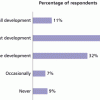

This is the first of a series of Executive Updates that examines the results of a recent Cutter Consortium survey on the subject of open source Java frameworks (OSJF). Here in Part I, I look at the reasons behind the recent surge in popularity of OSJF, which mostly arise from dissatisfaction with enterprise Java.



Abstract
Application developers need to handle a surprising amount of software technology. Platform suppliers cater to many architectural styles, thereby leaving a gap between their platforms and an application's business function. Filling this gap takes time and effort and reduces the "agility" -- simplicity and resilience -- of the application code.
The typical application development team is required to understand and code a great deal of relatively low-level software technology, including event management, transaction integrity, complex GUI frameworks, customization of development tools, configuration of code generators, error management, and logging.