


Strategic advice to leverage new technologies
Technology is at the heart of nearly every enterprise, enabling new business models and strategies, and serving as the catalyst to industry convergence. Leveraging the right technology can improve business outcomes, providing intelligence and insights that help you make more informed and accurate decisions. From finding patterns in data through data science, to curating relevant insights with data analytics, to the predictive abilities and innumerable applications of AI, to solving challenging business problems with ML, NLP, and knowledge graphs, technology has brought decision-making to a more intelligent level. Keep pace with the technology trends, opportunities, applications, and real-world use cases that will move your organization closer to its transformation and business goals.
Insight
Abstract
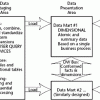
In this Executive Report, Ken Collier and Dan O'Leary introduce an enhanced data warehousing architecture designed to enable developers to respond quickly to new requirements and to adapt easily to change. The Message Driven Warehouse uses a generalized Java Message Service format to push rather than pull source data into a domain-independent, adaptive data model in the warehouse.
The business intelligence (BI) landscape has changed. New technologies enable more advanced BI applications for users. BI is no longer limited to an exclusive group of executives and analysts. Today's decision makers, from executives to frontline customer service representatives, need BI for decision support. BI is no longer just for strategic and tactical planning. Operational and near-real-time BI for the masses is the order of the day.


Companies that have adopted agile methods have realized faster throughput and higher business customer satisfaction on individual projects. Yet despite undeniable wins at the project level, sustained large-scale adoptions of agile methods are fewer and further between. What is preventing more comprehensive adoption of agile within organizations? Many agile experts point to a significant misalignment between the way agile projects are run and the way IT projects are governed in general. IT program and portfolio management, in particular, seem to be at the root of many of these alignment issues.
In this issue we'll explore ways to scale agile methods beyond individual projects so that their associated programs and portfolios can thrive. Hear how one agile consultant saved a failing 100-person company by introducing an agile portfolio planning game - and convincing the company to stop acquiring new customers (a much tougher sell)! Learn effective methods for ranking your projects - and the equally important lesson that "ranking isn't forever." Discover how to blend the adaptability of agile with the context and focus of traditional portfolio management to begin to deliver not just functions, but new organizational capabilities. Are the agile teams in your organization ready to level up?




One important concept about modeling is that models are based on a well-defined set of abstractions, relationships, and constraints. This is true whether the model is of a business process, a software component, or a data structure. However, the underlying concepts are all different, and so we use specialized modeling languages (or notations) to express them.



I've been covering business rules management systems (BRMS) for years now. However, I occasionally get the feeling that some still consider BRMS to be some sort of far-out technology. That's "far out" in the way of being too advanced or too out of reach for more mainstream end-user organizations to employ.

There have been a lot of announcements pertaining to open source BI (e.g., query, reporting, OLAP, dashboards) and data warehousing (data integration, data cleansing, etc.) tools over the past few years. But the big question on everyone's minds remains: to what extent are end-user organizations actually adopting open source BI and data warehousing tools?