Strategic advice to leverage new technologies
Technology is at the heart of nearly every enterprise, enabling new business models and strategies, and serving as the catalyst to industry convergence. Leveraging the right technology can improve business outcomes, providing intelligence and insights that help you make more informed and accurate decisions. From finding patterns in data through data science, to curating relevant insights with data analytics, to the predictive abilities and innumerable applications of AI, to solving challenging business problems with ML, NLP, and knowledge graphs, technology has brought decision-making to a more intelligent level. Keep pace with the technology trends, opportunities, applications, and real-world use cases that will move your organization closer to its transformation and business goals.
Insight
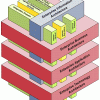

This is the final installment of our three-part Executive Updates series on the topic of operational business patterns. In Parts I and II, we showed how operational business patterns describe the essence of how an enterprise is organized to realize its value proposition, and we reviewed two example patterns.1
Executive Update
Finding the Needle in Any Haystack: Enterprise Search -- Part III
It's one thing to know generally how enterprise search can perform and in what specific markets -- it's another to understand the unique capabilities of representative products. This Executive Update is the last in a three-part series about enterprise search.


When I wrote my last Advisor, "An Agile View of Software Engineering" (16 October 2008), I did not expect to start such an intense discussion as it turned out to be. The reactions were intense both in terms of quantity and of quality -- a deep discussion on the relationship between software engineering and agile.




Following a recent keynote by a service-oriented architecture (SOA) evangelist, who waxed lyrical about the business promises of SOA at an enterprise architecture conference, one delegate commented, "I have a fundamental issue with people who say that SOA is a way of doing business -- it is not; it is a way of engineering IT applications."


Back in March, I discussed the need for tools that can mine social networking sites, such as LinkedIn, MySpace, YouTube, and Facebook (see "Mining Internet Social Media: Tomorrow's Tools Needed Today," 18 March 2008). Basically, I said that social media sites have become one of the leading mediums for publishing content on the Web.

Recently, I attended a conference that had a thin but interesting service-oriented architecture (SOA) track, with sessions such as "SOA: Hype or Happening" and "Security and Governance of Online and B2B SOA Traffic." While I attended both sessions, here I focus on the discussion in "SOA: Hype or Happening" as a followup to Part I of this two-part Executive Update series.1