



Strategic advice to leverage new technologies
Technology is at the heart of nearly every enterprise, enabling new business models and strategies, and serving as the catalyst to industry convergence. Leveraging the right technology can improve business outcomes, providing intelligence and insights that help you make more informed and accurate decisions. From finding patterns in data through data science, to curating relevant insights with data analytics, to the predictive abilities and innumerable applications of AI, to solving challenging business problems with ML, NLP, and knowledge graphs, technology has brought decision-making to a more intelligent level. Keep pace with the technology trends, opportunities, applications, and real-world use cases that will move your organization closer to its transformation and business goals.
Insight

Until humans, applications, and networks become infallible, computer systems are going to generate errors. Identifying and correcting these errors is a task as critical to perform as it is unglamorous. As a veteran programmer said to me early in my career, "The older you get, the less time you'll spend thinking about new functionality and the more time thinking about handling errors in what you've already got."



I remember the phone call well. My boss asked for a 13% reduction in budget quickly. A bit numb, my first reaction was to object, but the tone in his voice suggested that I shouldn't. I had to let a day pass to get over the emotional reaction and then I got to work. How can I cut costs without making my future a living hell?



A reader asked recently why I thought that data mining techniques are not in use at more organizations. This question is interesting in that the typical organization today tends to have huge amounts of data at its disposal. In addition, there have been significant advances in data collection, integration, and storage, with the data warehousing concept now quite widely accepted.


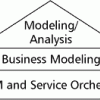

In preparation for attending a conference, I noticed a session called "SOA: Hype or Happening?" Even though the session did not advertise more probing and intriguing questions, I opted to attend that session, though I thought a better concept would be "A Checkpoint on the Progress of the SOA Platform."
In my mind's eye, I see service-oriented architecture (SOA) in the real world as having more to do with discussions revolving around these questions: