


Strategic advice to leverage new technologies
Technology is at the heart of nearly every enterprise, enabling new business models and strategies, and serving as the catalyst to industry convergence. Leveraging the right technology can improve business outcomes, providing intelligence and insights that help you make more informed and accurate decisions. From finding patterns in data through data science, to curating relevant insights with data analytics, to the predictive abilities and innumerable applications of AI, to solving challenging business problems with ML, NLP, and knowledge graphs, technology has brought decision-making to a more intelligent level. Keep pace with the technology trends, opportunities, applications, and real-world use cases that will move your organization closer to its transformation and business goals.
Insight

Abstract
Systematic and deliberate knowledge management (KM) of knowledge-related processes and intellectual capital (IC) assets is pursued by competent enterprises throughout the world. Its purpose is to facilitate enterprise actions to be highly effective by building, maintaining, making available, and safeguarding IC assets from operational, tactical, and strategic perspectives.
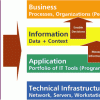

This Executive Report looks at common architectural titles and roles and describe what responsibilities are typically associated with those roles. Then, it looks at the skills that all architects have in common and describe 10 things that every architect can do to add value to his or her organization.


One of the problems with the IT field is that, absent something like the model year for cars popularized by Alfred Sloan in the 1920s, IT companies have to keep coming up with new terms for old ideas. Recently, I've found myself in meetings with consultants and IT managers in which the term "metadata" has been used to allow a group of clueless participants seem with it.
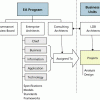
This Executive Summary and its accompanying Executive Report look at common architectural titles and roles and describe what responsibilities are typically associated with those roles. Then, it explores the skills that all architects have in common and describe 10 things that every architect can do to add value to his or her organization. Not a client? Receive a complimentary copy of this report.




Last week, Oracle announced two new products targeted at high-performance data warehousing applications: the HP Oracle Database Machine and the Oracle Exadata Storage Server. These products package hardware from HP with database accelerator software from Oracle to form what is essentially a high-performance data warehousing appliance.

If there is to be a true discipline of software engineering, then those of us "doing software engineering" should look closely at how those people in other disciplines who call themselves "engineers" or "architects" actually go about "doing engineering"