Strategic advice to leverage new technologies
Technology is at the heart of nearly every enterprise, enabling new business models and strategies, and serving as the catalyst to industry convergence. Leveraging the right technology can improve business outcomes, providing intelligence and insights that help you make more informed and accurate decisions. From finding patterns in data through data science, to curating relevant insights with data analytics, to the predictive abilities and innumerable applications of AI, to solving challenging business problems with ML, NLP, and knowledge graphs, technology has brought decision-making to a more intelligent level. Keep pace with the technology trends, opportunities, applications, and real-world use cases that will move your organization closer to its transformation and business goals.
Insight
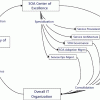
Most commentators agree that a service-oriented architecture (SOA) center of excellence (CoE) is a critical component in a successful SOA. But what exactly is an SOA CoE, and how is it structured? When is it relevant, and how does it grow? What roles are involved, and how do they interact with other existing roles? To provide guidance about the SOA CoE, this Executive Update examines these questions and more.


The IT shop aside, most firms find it difficult to truly become customercentric. Many firms have paid dearly for all kinds of studies on their customers, including research under the banner of voice-of-customer (VOC), customer experience, customer-relationship management (CRM) strategy, customer loyalty and retention, and good old-fashioned market research.



Data warehouse vendor Infobright Inc. has introduced an open source version of its Infobright enterprise data warehouse product. Infobright Community Edition (ICE), as the new open source offering is called, is similar to the company's main commercial data warehousing package: Infobright Data Warehouse Enterprise Edition.


In the first part of this series (see "Collaboration: What Does It Mean? Part I," 3 September 2008), we discussed the opportunities provided by new technologies in creating business value with collaboration.

Last week, I discussed how I saw Web 2.0 and search affecting BI (see "Web 2.0, Search, and the Future of Business Intelligence," 9 September 2008). Basically, I said that one of the most important technologies that will have a major influence on BI is search; specifically, the blending of BI and enterprise search technologies.


In the current edition of Communications of the Association of Computing Machinery (CACM), there is an extremely important article for everyone involved in mission-critical software. The article is titled "Software Engineering and Formal Methods" and is written by a number of illustrious software scientists.