


Strategic advice to leverage new technologies
Technology is at the heart of nearly every enterprise, enabling new business models and strategies, and serving as the catalyst to industry convergence. Leveraging the right technology can improve business outcomes, providing intelligence and insights that help you make more informed and accurate decisions. From finding patterns in data through data science, to curating relevant insights with data analytics, to the predictive abilities and innumerable applications of AI, to solving challenging business problems with ML, NLP, and knowledge graphs, technology has brought decision-making to a more intelligent level. Keep pace with the technology trends, opportunities, applications, and real-world use cases that will move your organization closer to its transformation and business goals.
Insight



Abstract
This Executive Report describes applied research that is intended to help readers understand and measure the impact of the deployment of technologies commonly referred to as Web 2.0. These technologies include wikis, blogs, podcasts, folksonomies, mashups, social networks, virtual worlds, and RSS filters.

The accompanying Executive Report describes applied research that is intended to help readers understand and measure the impact of the deployment of the technologies collectively known as Web 2.0. These include wikis, blogs, podcasts, folksonomies, mashups, social networks, virtual worlds, and RSS filters.
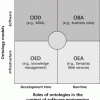

IT environments and platforms are becoming more capable of satisfying incrementally demanding operational requirements, and development methodologies are evolving accordingly. To achieve streamlined and agile processes, complex systems rely increasingly on flexible, unified models and integrated system views.


Abstract
This Executive Report by Sebastian Konkol focuses on temporalities embedded in enterprise architecture and offers a means of organizing them inside technology management processes.

Although the necessity of refactoring is not being questioned by agile developers, its business justification has always been doubted by "outsiders." The accompanying Executive Report proposes a means of support for refactoring efforts and initiatives through enterprise architecture (EA), specifica
Executive Update
A Practical Guide to Crafting an Agile Adoption Strategy
Many of us struggle with getting real business value out of new techniques and practices. Agile software development is no different than any other development method in that regard. If you practice it "by the book," you may or may not get the business values you need.1 I hope you have clarity about the business values that are most important to your teams and your organizations.