


Strategic advice to leverage new technologies
Technology is at the heart of nearly every enterprise, enabling new business models and strategies, and serving as the catalyst to industry convergence. Leveraging the right technology can improve business outcomes, providing intelligence and insights that help you make more informed and accurate decisions. From finding patterns in data through data science, to curating relevant insights with data analytics, to the predictive abilities and innumerable applications of AI, to solving challenging business problems with ML, NLP, and knowledge graphs, technology has brought decision-making to a more intelligent level. Keep pace with the technology trends, opportunities, applications, and real-world use cases that will move your organization closer to its transformation and business goals.
Insight
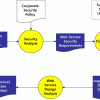
While CORBA has less than a handful of program language bindings, Web services clients can be a JavaServer Page, servlet, or Java application or an executable written in languages such as C++, Perl, Visual Basic, JavaScript, and so on -- it's a truly ubiquitous protocol.
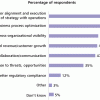





I've been working with many companies lately whose IT systems are dominated by enterprise resource planning (ERP). This is not surprising, since an ERP system is an essential part of most IT portfolios today. In many organizations, the ERP system contributes as much as 70% of the total IT capability.
For organizations struggling with their master data management (MDM) strategies, underway or planned, the solution for success may not lie in better technical justifications or in more concrete ROI discussions, but in a better customer service and IT marketing strategy.

The majority of organizations that have implemented or are planning to implement business performance management solutions rely on a data warehouse to support the data integration requirements of their performance management initiatives. This finding comes from a Cutter Consortium survey conducted in January 2008 of 101 end-user organizations based worldwide.




I recall a conference presentation titled "Software engineering? An Oxymoron?" that I attended about five years ago. The speaker was pushing the idea that the software development practice had to borrow concepts from the engineering domain, where the formal approach in design and build was a common practice consolidated over 2,000 years.