

Strategic advice to leverage new technologies
Technology is at the heart of nearly every enterprise, enabling new business models and strategies, and serving as the catalyst to industry convergence. Leveraging the right technology can improve business outcomes, providing intelligence and insights that help you make more informed and accurate decisions. From finding patterns in data through data science, to curating relevant insights with data analytics, to the predictive abilities and innumerable applications of AI, to solving challenging business problems with ML, NLP, and knowledge graphs, technology has brought decision-making to a more intelligent level. Keep pace with the technology trends, opportunities, applications, and real-world use cases that will move your organization closer to its transformation and business goals.
Insight
In the October 2007 Cutter IT Journal, I contributed an article to the special issue on "Fostering Innovation: What Role Does Agile Software Development Play?" That article, titled "Agile and UCD: Can This Marriage Be Saved?," presented a case study of a company that went from waterfall to agile, with the loss of usability testing as an unexpected outcome. In its place, the product manager stood in for the customer/user.


Despite several alternatives, most end-user organizations currently choose to develop their business performance management applications themselves. This trend is subject to change, however, because many organizations that are planning to implement performance management applications are still undecided as to how they will do so. Market conditions are changing as well.


Executive Update
Mining Blogs for Business Benefits
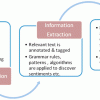
Blogs and other social media tools have become quite a permanent phenomenon in the online world. Today, the tremendous community interaction on blogs is a potential hotbed for companies ever eager to gain market insights. Naturally, companies are setting up blogging infrastructures and engaging themselves in eliciting information from these blogs.
In companies everywhere today, it is increasingly common to find people acting in explicitly named "business architect" roles. Currently, there is no industry-wide, consistent definition of the role, and there are vast differences in how organizations choose to utilize their business architects.


"Even though they (and we) may not know it, all organizations already have an embryonic business architecture in place. But today’s problems require a more formal business architecture to connect the business with the technologies it increasingly depends on."
-- Ken Orr, Guest Editor


So what is business architecture (BA)? It means different things to different people, and I'm not going to try to define it here. Instead, I'll describe what aspects of BA I'm concerned with when doing a service-oriented architecture (SOA) project. We all say the service design should be driven by the business, but to be more precise, I say BA must answer the following questions:
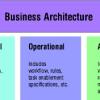
The term "business architecture" means many things to many people. Perhaps this is due to its peculiar combination of the term "business" with the term "architecture." Since architecture is generally discussed in reference to the IT community, the juxtaposition with the term "business" is somewhat unsettling. What does it mean to architect a business, after all?