Strategic advice to leverage new technologies
Technology is at the heart of nearly every enterprise, enabling new business models and strategies, and serving as the catalyst to industry convergence. Leveraging the right technology can improve business outcomes, providing intelligence and insights that help you make more informed and accurate decisions. From finding patterns in data through data science, to curating relevant insights with data analytics, to the predictive abilities and innumerable applications of AI, to solving challenging business problems with ML, NLP, and knowledge graphs, technology has brought decision-making to a more intelligent level. Keep pace with the technology trends, opportunities, applications, and real-world use cases that will move your organization closer to its transformation and business goals.
Insight
When asking a typical IT manager about a single area where an enterprise architecture (EA) effort should be able to prove its value, probably the most expected answer would be "giving support to projects being run." It is not my ambition here to present the whole scope of possibilities in which EA could support running projects but rather to focus on the refactoring needs concept introduced in Part of this series. Recall that Part II presented refactoring needs in the context of an actual case study in which I worked. Here in Part III, I continue with that case and get into more details about how the refactoring needs built on an EA could support and synergize ongoing software development projects.
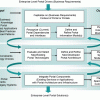

Over the last few years, it has become clear to many practitioners that a portal can add distinct value, agility, robustness, and versatility to their business applications [1, 3, 4, 6]. A portal can introduce the doorway to a common view while providing access to applications in multiple organizations of the enterprise.






I've been saying for years now that I believe that one of the most important developments in business process management (BPM) involves the application of analytics to monitor and analyze the efficiency of distributed business processes.1 Today it is possible to monitor business processes as they execute and to display the findings -- based on calculated key performance indicators

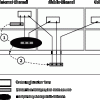
Enterprise architecture (EA) provides much more real value to an organization when it pervades various aspects of day-to-day IT efforts. In Part I of this Executive Update series, I introduced a concept that binds EA with change management and refactoring [1].