Strategic advice to leverage new technologies
Technology is at the heart of nearly every enterprise, enabling new business models and strategies, and serving as the catalyst to industry convergence. Leveraging the right technology can improve business outcomes, providing intelligence and insights that help you make more informed and accurate decisions. From finding patterns in data through data science, to curating relevant insights with data analytics, to the predictive abilities and innumerable applications of AI, to solving challenging business problems with ML, NLP, and knowledge graphs, technology has brought decision-making to a more intelligent level. Keep pace with the technology trends, opportunities, applications, and real-world use cases that will move your organization closer to its transformation and business goals.
Insight

Executive Summary
The State of SOA Today
In a 2006 issue of Cutter Benchmark Review (CBR), Rudy Hirschheim and I talked about the emergence of service-oriented architecture (SOA). Since that time, there has been increased attention on SOA, both within the practitioner press and by vendors. Yet my own experiences from observing organizations implementing SOA caused me to wonder about the current state of SOA.
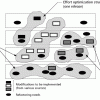

One of the most vital concerns for enterprise architecture (EA) is its evolution: the ability to purposely shape EA with regard to various small changes introduced to an IS environment. The issue of implementing changes to EA in a coordinated manner was the genesis for the concept described in the previous parts of this Executive Update series [1-3].


INTRODUCTION
First, I want to start off by thanking all my friends, colleagues, and clients in Latin America. Over the past two years, I've had the opportunity and privilege to work with many great people and organizations, as well as to share my enthusiasm for architecture with like-minded people in an emerging market. This has been a wonderful experience, and I look forward to continuing to help the market mature and grow over the next few years.


Abstract
Content management represents a critical area of infrastructure for the enterprise. As content becomes digitized, managed, and accessible through portals, the advantages of bringing most if not all content under a single management scheme become more apparent.

Content management represents a critical area of infrastructure for today's enterprise as it attempts to manage the vast flood of new digital content now arriving as a result of multimedia and Enterprise 2.0 developments and to provide the framework of controls that is necessary to meet increasing demands for efficiency, security, legal discovery, and compliance.
Retailers increasingly rely on sophisticated information technology to support the management of their supply chains. Retailers track the flow of material between their stores, distribution centers, and upstream suppliers. Ideally, they share detailed information across and within the firm pertaining to inventory, forecast sales, actual sales, and delivery schedules, among other key metrics. To incorporate this information into formats useful to users, retailers are turning to scorecards.