



Strategic advice to leverage new technologies
Technology is at the heart of nearly every enterprise, enabling new business models and strategies, and serving as the catalyst to industry convergence. Leveraging the right technology can improve business outcomes, providing intelligence and insights that help you make more informed and accurate decisions. From finding patterns in data through data science, to curating relevant insights with data analytics, to the predictive abilities and innumerable applications of AI, to solving challenging business problems with ML, NLP, and knowledge graphs, technology has brought decision-making to a more intelligent level. Keep pace with the technology trends, opportunities, applications, and real-world use cases that will move your organization closer to its transformation and business goals.
Insight
A plethora of publications today emphasize the significance of business drivers in adopting service-oriented architecture (SOA). It is also evident that embracing SOA requires significant (if not equal) investments of time and energy on the part of decision-making business leaders and IT practitioners.


It has been said many times that service-oriented architecture (SOA) is not something you buy, but is rather an architectural approach to building applications by combining services together. A Google search for "can't buy SOA" and its variations yields about 50 articles from the past two years elaborating on this point.




Auto-ID technology began in 1999 with the formation of a consortium that sponsored research at the Massachusetts Institute of Technology (MIT) in Cambridge, Massachusetts, USA. After several years of development and testing, MIT licensed Auto-ID technology to GS1, the nonprofit standards organization responsible for the implementation of bar code standards during the 1970s.


Enterprise search -- the ability for employees to use a search engine to locate and retrieve relevant information pertinent to their jobs as easily as it is for them to dredge up the latest consumer information on the Internet -- continues to generate a lot of attention in the press and at conferences.

Last week, I discussed business process management vendor TIBCO Software, Inc.'s purchase of BI analytics vendor Spotfire (see "TIBCO Buys Spotfire: BI to Become Just Another Process?" 8 May 2007). The week before, it was Business Objects' acquisition of business performance management vendor Cartesis S.A.
Executive Update
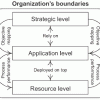
A Three-Level Enterprise Architecture Based on Web Services
In this Executive Update, we propose a three-level enterprise architecture that allows organizations to manage their computer and information assets -- hardware, software, processes, and data -- based on the Web services model. We denote these levels as resource, application, and strategic.