

Strategic advice to leverage new technologies
Technology is at the heart of nearly every enterprise, enabling new business models and strategies, and serving as the catalyst to industry convergence. Leveraging the right technology can improve business outcomes, providing intelligence and insights that help you make more informed and accurate decisions. From finding patterns in data through data science, to curating relevant insights with data analytics, to the predictive abilities and innumerable applications of AI, to solving challenging business problems with ML, NLP, and knowledge graphs, technology has brought decision-making to a more intelligent level. Keep pace with the technology trends, opportunities, applications, and real-world use cases that will move your organization closer to its transformation and business goals.
Insight
Advisor
Let's Buy an Architecture
In the field of enterprise architecture, many architects are very critical of John Zachman's well-known framework. A number of extensions have been proposed for the framework (see, for example, the work of Cutter Senior Consultant Ken Orr, including his Executive Report "Business Enterprise Architecture Modeling").

If the year ended today, I'd be inclined to say that probably the two most significant events that have taken place concerning the BI world both have to do with Microsoft. The first was Microsoft buying BI and analysis tools vendor ProClarity Corporation back in April. The second was Microsoft announcing plans in June that it intends to market a business performance management application -- Office PerformancePoint Server 2007 -- based on a combination of ProClarity's and Microsoft's own BI technologies.

Strategic work on EA should not be confused with portfolio and project planning. IT strategy is an important input to the project portfolio (and ultimately budget) planning process, but it is not the only one. Any IT organization will have to run both strategically aligned projects as well as projects that respond to the current business units' woes and pains. Confusing the two might push a strategic EA team into too low a level of detail.
This week, I thought I'd comment on some of the important recent developments that have taken place in the data warehousing extraction, transformation and loading (ETL) tools market.
Oracle Warehouse BuilderOracle finally released the latest version of its Oracle Warehouse Builder ETL toolset (version 10G, release 2). This is the eighth release of the product since Oracle started marketing it in 2000.
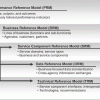

The Federal Enterprise Architecture (FEA) is incomplete and evolving. However, it has reached a level of detail and prevalence within the US federal government that agencies are now developing or honing FEA-based enterprise architecture programs, and system development projects include FEA considerations.
The Federal Enterprise Architecture (FEA) is incomplete and evolving. However, it has reached a level of detail and prevalence within the US federal government that agencies are now developing or honing FEA-based enterprise architecture programs, and system development projects now include FEA considerations.

This is the second Executive Update in a series of three that examines enterprise architecture (EA) -- specifically, its organization and programs, how it provides governance, and the value it brings to companies. The series is based on data from a recent Cutter Consortium survey.
Executive Report
Critically Thinking About CSFs in Enterprise Systems
Enterprise systems (ES) are being widely adopted by organizations in all types of industry and geographical locations, and there now exists considerable research on the impact of ES implementations on these organizations [6, 7]. The promoted strategic advantage of an ES is that it can integrate business functions into a single system with a shared database, allowing organizations to develop a homogenous enterprise-wide information systems (IS) infrastructure.