

Strategic advice to leverage new technologies
Technology is at the heart of nearly every enterprise, enabling new business models and strategies, and serving as the catalyst to industry convergence. Leveraging the right technology can improve business outcomes, providing intelligence and insights that help you make more informed and accurate decisions. From finding patterns in data through data science, to curating relevant insights with data analytics, to the predictive abilities and innumerable applications of AI, to solving challenging business problems with ML, NLP, and knowledge graphs, technology has brought decision-making to a more intelligent level. Keep pace with the technology trends, opportunities, applications, and real-world use cases that will move your organization closer to its transformation and business goals.
Insight
Executive Update
A Democratic Revolution in Business Intelligence?
Putting the power of useful information into more hands in the organization has been a goal of business intelligence (BI) efforts beyond reproach, but what obstacles has achieving this objective created from a technology and management perspective? "Data democratization" in the BI domain is a trend worth watching because it reveals how chaotic and raucous democracy can be.
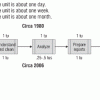
LIVE AND LEARN
I had the privilege of working as a member of groups that performed what we would now call "data mining" at Bell Labs in the early 1980s though the mid-1990s. Though I haven't done any hands-on data mining recently, I've seen dozens of similar projects in the ensuing years.
THE LURE OF COMPLEXITY
When data analysts (myself included) are engaged by a business customer, we have an unfortunate tendency to suggest more complicated analyses than are immediately necessary or desirable for the end goal of improving business practices and profits. We are armed with sophisticated software that will allow the application of impressive and complex algorithms -- this is like candy to an analyst.

In his call for papers, Guest Editor Ken Collier wrote:
"Business intelligence" (BI) has become the de facto umbrella term for describing all activities related to using business data to run the business. For decades business leaders have relied on cross-tab style reports for analysis and decision making, and they have always sought easier and more powerful tools for better analysis.

Material for this article has been adapted from Sid Adelman, Larissa Moss, and Majid Abai, Data Strategy (Addison-Wesley Professional, 2005).
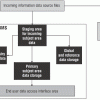
In recent years, there has been an ever-increasing need for long-term database management systems to support the research of natural resource monitoring and assessment. As governmental regulation and public awareness of environmental issues increase, the growing number of these systems can and will present a different set project objectives, data storage and management requirements, and analytical result capabilities.
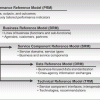

The Federal Enterprise Architecture (FEA) is incomplete and evolving. However, it has reached a level of detail and prevalence within the US federal government that agencies are now developing or honing FEA-based enterprise architecture programs, and system development projects include FEA considerations.

It seems like architecture as an IT profession has finally hit the big time, judging by conferences if nothing else. Last week I presented at Dr. Dobb's Architecture and Design World 2006 in Chicago, Illinois, USA. This is not the first time I've presented at an architecture conference, but it is the first time I remember being impressed by how many people were present.