


Strategic advice to leverage new technologies
Technology is at the heart of nearly every enterprise, enabling new business models and strategies, and serving as the catalyst to industry convergence. Leveraging the right technology can improve business outcomes, providing intelligence and insights that help you make more informed and accurate decisions. From finding patterns in data through data science, to curating relevant insights with data analytics, to the predictive abilities and innumerable applications of AI, to solving challenging business problems with ML, NLP, and knowledge graphs, technology has brought decision-making to a more intelligent level. Keep pace with the technology trends, opportunities, applications, and real-world use cases that will move your organization closer to its transformation and business goals.
Insight
As enterprise architecture becomes more commonplace, many organizations realize that they don't have the appropriate level of skills in-house to staff the positions. An obvious approach is to look to a training program. In discussions about training, I'm often asked about certification programs for enterprise architects. Given that EA is a relatively new field, there aren't a lot of options for certification as yet, and just as important, there aren't any specific certifications that are generally recognized within the industry.

For some time now, I've been saying that compliance applications have become a major driver for companies to apply business rules management systems (BRMS) (see, for example, "Rule-Based Systems for Customer Privacy Compliance," 10 May 2005).

A while ago, I took part in a meeting aimed at project scope definition. The goal of the meeting was to define the main aspects of business context, which required application of quite advanced statistical analysis tools (statistical scoring cards) in the scope of operational business processes decision supporting tasks (liabilities collection process).
A couple of weeks ago, I discussed recent Cutter research that found that just 10% of (end-user) organizations surveyed say they are currently running a data warehouse or data mart on Linux (see "Corporate Adoption of Open Source Linux for Data Warehousing," 20 June 2006).
Executive Update
Standardizing Management of Knowledge
As the problem child of business intelligence, knowledge management (KM) has suffered an identity crisis for some time, which explains organizations' total lack of enthusiasm today for any technology or management strategy yoked to those two words. As I pointed out in a previous Executive Report [1], KM means almost anything, therefore it means almost nothing.
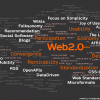

In the time-honored tradition of earlier buzzwords such as "dot-com," "Web services," and "business process management," the media and the blogosphere are currently humming with discussion of a phenomenon called "Web 2.0." The implication of this name is that the original Web, "Web 1.0," has somehow become worn out or obsolete, and that it is fast being replaced with a newer, better model.
The blogosphere and, increasingly, the media are humming with excitement about Web 2.0. But what lies behind this catchy new buzzword, and does it really represent a step forward from the "old" Web? Even enthusiasts do not agree on just what defines a "Web 2.0 site," and when they brainstorm the question, the resulting feature lists can grow to remarkable lengths.
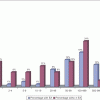
This is the first Executive Update in a series of three that examines enterprise architecture (EA) -- specifically, its organization and programs, how it provides governance, and the value it brings to companies. The series is based on data from a recent Cutter Consortium survey.