


Strategic advice to leverage new technologies
Technology is at the heart of nearly every enterprise, enabling new business models and strategies, and serving as the catalyst to industry convergence. Leveraging the right technology can improve business outcomes, providing intelligence and insights that help you make more informed and accurate decisions. From finding patterns in data through data science, to curating relevant insights with data analytics, to the predictive abilities and innumerable applications of AI, to solving challenging business problems with ML, NLP, and knowledge graphs, technology has brought decision-making to a more intelligent level. Keep pace with the technology trends, opportunities, applications, and real-world use cases that will move your organization closer to its transformation and business goals.
Insight
It has always been the case that as an organization gets bigger and more diverse, it becomes progressively harder for separate groups to communicate with each other. In the modern age, however, it has become increasingly more important not only for people from different departments to work together, but also for their systems to work together.
Executive Update
Standardizing Management of Knowledge
As the problem child of business intelligence, knowledge management (KM) has suffered an identity crisis for some time, which explains organizations' total lack of enthusiasm today for any technology or management strategy yoked to those two words. As I pointed out in a previous Executive Report [1], KM means almost anything, therefore it means almost nothing.
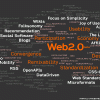

In the time-honored tradition of earlier buzzwords such as "dot-com," "Web services," and "business process management," the media and the blogosphere are currently humming with discussion of a phenomenon called "Web 2.0." The implication of this name is that the original Web, "Web 1.0," has somehow become worn out or obsolete, and that it is fast being replaced with a newer, better model.

One of the reoccurring themes in the press these days is SaaS or Software-as-a-Service. And, like most hot new buzzwords, it means different things to different people.

No doubt about it, the software as a service (SaaS) model has taken on a life of its own. It seems that hardly a day goes by without some vendor announcing some sort of new service offering. Even the business rules management system (BRMS) vendors are jumping onto the SaaS bandwagon.
Compliance applications have become a major driver for organizations to apply business rules management systems (BRMS). By externalizing rules from critical processes and applications, organizations can create a centralized repository of compliance rules that they can apply across different departments, divisions, and channels, thus helping to standardize and coordinate company-wide strategies for meeting company and governmental regulations such as BASEL II, Sarbanes-Oxley, and Do-Not-Call.

The reasons why enterprises pursue systematic knowledge management (KM) are clear: they wish to make people -- and the whole enterprise -- act intelligently to operate more effectively and satisfy their stakeholders better. However, practical issues of how to approach, introduce, or expand KM practices are complex. When KM practices are implemented in an enterprise, the efforts become continual processes that will go on for years.
Practically no area of corporate computing remains untouched by the open source Linux movement. Consequently, a big question on a lot of data warehousing and BI practitioners' minds has been: to what extent are companies actually adopting open source Linux for their data warehousing platforms?
A recent survey we conducted in April 2006 that asked 106 end-user organizations (of various sizes based worldwide) about their plans to use open source BI and data warehousing tools helps provide some insight on this issue.