

Strategic advice to leverage new technologies
Technology is at the heart of nearly every enterprise, enabling new business models and strategies, and serving as the catalyst to industry convergence. Leveraging the right technology can improve business outcomes, providing intelligence and insights that help you make more informed and accurate decisions. From finding patterns in data through data science, to curating relevant insights with data analytics, to the predictive abilities and innumerable applications of AI, to solving challenging business problems with ML, NLP, and knowledge graphs, technology has brought decision-making to a more intelligent level. Keep pace with the technology trends, opportunities, applications, and real-world use cases that will move your organization closer to its transformation and business goals.
Insight
Executive Update
Mainframe Rehosting: Look Before You Leap
INTRODUCTION
The mainframe mammoths have no doubt served their masters well over the decades and are known for their legendary reliability and stability. However, during today's times of tighter budgets, attention naturally turns to these expensive computing resources in order to reduce costs. Additionally, the need to address changing business requirements more quickly and the need to cater to a broader spectrum of end users make it pertinent for these legacy systems to be modernized.
Editor's note: All uncited remarks and quotations used in this report are from personal phone interviews with the author.
Business processes are the muscle of any organization's operations and thus merit preeminent attention if enterprises want to be more cost-effective, productive, agile, and therefore technologically future-proof and competitive in the long run. Enter business process management (BPM). BPM is more than a technology; it's also a process. It manages multistep, long-lived transactions and messages through processes that span multiple applications, departments, and organizations.
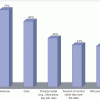

This Executive Update is the third in a series of Updates stemming from a December 2005 Cutter Consortium survey addressing business intelligence (BI) outsourcing. The survey asked 140 companies worldwide about their BI practices and their plans or predispositions for outsourcing these practices to third-party experts.

In 1990, Motorola's cellular infrastructure group took a step up the quality ladder. The managers of its newly reorganized division decided that the way to improve their cellular products was to get customers more involved in the development process. One of the most noticeable signs of this decision was the revolutionary practice of inviting customers to be present at the organization's quality reviews.
Executive Summary
Risk Analysis for Agile Outsourcing
There are two parallel trends in the field of IT that try to address the expense associated with developing quality software. The first is the adoption of various agile software development methodologies, such as Extreme Programming (XP) and Scrum, and the second is the trend to outsource software development offshore to countries where wages are significantly less than in the US.

My last two Trends Advisors in this series (see "Real Enterprise Data Architecture, Parts 1 and 2," 23 February and 9 March 2006) have focused on what I refer to as real enterprise data architecture, which in enterprise architecture terms is equivalent to distinguishing the forests from the trees in the enterprise data space.
By now you have most likely heard of or been exposed to the lo-tech agile practice of using 3x5 cards to capture user stories, plan development, and track an agile project. Needless to say, this technique has terrified more than a few development managers and leaders and in many cases the strengths associated with agile development have been thrown out along with the "crazy" idea of using index cards for requirements.