


Strategic advice to leverage new technologies
Technology is at the heart of nearly every enterprise, enabling new business models and strategies, and serving as the catalyst to industry convergence. Leveraging the right technology can improve business outcomes, providing intelligence and insights that help you make more informed and accurate decisions. From finding patterns in data through data science, to curating relevant insights with data analytics, to the predictive abilities and innumerable applications of AI, to solving challenging business problems with ML, NLP, and knowledge graphs, technology has brought decision-making to a more intelligent level. Keep pace with the technology trends, opportunities, applications, and real-world use cases that will move your organization closer to its transformation and business goals.
Insight
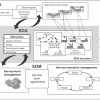

It seems that enterprise architecture (EA) is finally becoming mainstream. Opinions on what is driving this trend are as varied as the opinions on EA itself, ranging from requirements on government agencies to IT complexity and the new economy to requirements for IT/business alignment and service-oriented architecture (SOA). Although we could debate which of these factors are at work, there is little doubt that EA programs are proliferating.
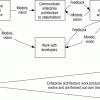

Over the years, I've had the pleasure of working in a range of IT organizations around the world, and I've often worked with, or at least reviewed, many of the enterprise architecture (EA) teams within those organizations. In all cases, the EA team is staffed with some of the best and brightest within IT, all of whom have the organization's best interests at heart.
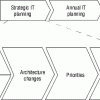

In today's turbulent economy, change is the only thing we can be sure about. It is primarily the ever-changing business and technical environment and increasing pressure to shorten the time of just about everything we do in business that has made the agile approaches to common management practices popular.
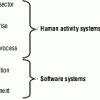


As consultant-educators, we need to be able to quickly grasp an organization's architecture at different levels of abstraction. We have created a new framework, the Extreme Architecture Framework (XAF), in order to do just that. The XAF presents a unified view of human activity and software systems from the perspectives of business, information, and technology. The unified view strikes a balance between architectural perfection and the chaos that inevitably ensues when there is no architecture.

NCR Teradata announced it is buying supply chain analytics application vendor SeeCommerce for an undisclosed amount. Teradata will use SeeCommerce's packaged supply chain intelligence (SCI) applications to bolster its Teradata Demand and Supply Chain offerings.
What Is Teradata Actually Buying?SeeCommerce offers SeeChain -- a packaged SCI application, whose various modules cover a range of supply chain domains and processes, including:
Executive Report
The Role of Master Data Management in the Enterprise
A NEW NAME FOR AN OLD PROCESS
It should come as no surprise to anyone in the IT world that old concepts often reemerge under new, more mysterious sounding titles. Navigating the world of IT is like taking a trip through a bowl of alphabet soup. But while the names and terminology may change, the core concepts usually stay the same.