


Strategic advice to leverage new technologies
Technology is at the heart of nearly every enterprise, enabling new business models and strategies, and serving as the catalyst to industry convergence. Leveraging the right technology can improve business outcomes, providing intelligence and insights that help you make more informed and accurate decisions. From finding patterns in data through data science, to curating relevant insights with data analytics, to the predictive abilities and innumerable applications of AI, to solving challenging business problems with ML, NLP, and knowledge graphs, technology has brought decision-making to a more intelligent level. Keep pace with the technology trends, opportunities, applications, and real-world use cases that will move your organization closer to its transformation and business goals.
Insight
Fast-changing times demand adaptability. With ever-tighter deadlines and the constant newness of technical challenges, it's often difficult to size projects. Even as times change, this fundamental problem remains. Many want to know whether sizing metrics that we learned in the past, such as function points, are adaptable to new and different environments.
It's been going on for years: the notion that every time a new technology, methodology, or approach comes on the software scene, we need new metrics to manage the software project. Although it is definitely true that new technologies bring differences in productivity and quality, there are some metrics that never go out of style -- because the fundamental principles on which they are based have not changed.
Article
Build In Quality
"Getting people to do better all the worthwhile things they ought to be doing anyway." That is the language with which Philip B. Crosby began his now famous book Quality is Free: The Art of Making Quality Certain (McGraw-Hill, 1979). "People" includes management, he went on to say, but it is up to the professionals in a field to instruct management about this portion of the management job. What can management do to make software quality more certain?
Software projects are notorious for being late, over budget, and delivered with poor reliability. In the past this has often been due to ambitious attempts to take on the construction of large amounts of functionality within very aggressive market deadlines. Increasingly, one solution involves partitioning large release projects into smaller subsystems, each developed by separate smaller teams. Then the subsystems are integrated and validated to provide the final product release.
It almost goes without saying that it's important to get Web systems right. Not only have they come to play an increasingly important role in support-ing critical business functions, but organizations are spending increasing amounts on these systems. A recent IDC report predicted that US expenditures on Web-based initiatives would grow from US $12 billion in 1999 to $43.6 billion in 2002!
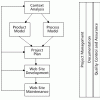
Although the development of Web applications may seem easy, it is often more complex and challenging than many of us think. In many ways, it is also different and more complex than traditional software development [6].

As the new millennium begins, we have almost come full circle in our approach to software design.
The practice of software design has evolved in interesting ways over the past 30 years, along with the complexity and the capabilities of computer software itself. In many ways, this evolution takes the form of a pendulum swinging: from very little formal software design in the beginning to the excessively detailed and documented design of software engineering in the 1980s and early 1990s.