

Strategic advice to leverage new technologies
Technology is at the heart of nearly every enterprise, enabling new business models and strategies, and serving as the catalyst to industry convergence. Leveraging the right technology can improve business outcomes, providing intelligence and insights that help you make more informed and accurate decisions. From finding patterns in data through data science, to curating relevant insights with data analytics, to the predictive abilities and innumerable applications of AI, to solving challenging business problems with ML, NLP, and knowledge graphs, technology has brought decision-making to a more intelligent level. Keep pace with the technology trends, opportunities, applications, and real-world use cases that will move your organization closer to its transformation and business goals.
Insight
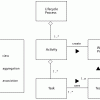
It almost goes without saying that it's important to get Web systems right. Not only have they come to play an increasingly important role in support-ing critical business functions, but organizations are spending increasing amounts on these systems. A recent IDC report predicted that US expenditures on Web-based initiatives would grow from US $12 billion in 1999 to $43.6 billion in 2002!
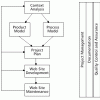
Although the development of Web applications may seem easy, it is often more complex and challenging than many of us think. In many ways, it is also different and more complex than traditional software development [6].

As the new millennium begins, we have almost come full circle in our approach to software design.
The practice of software design has evolved in interesting ways over the past 30 years, along with the complexity and the capabilities of computer software itself. In many ways, this evolution takes the form of a pendulum swinging: from very little formal software design in the beginning to the excessively detailed and documented design of software engineering in the 1980s and early 1990s.
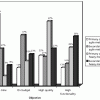

"My hat's in the ring. The fight is on, and I'm stripped to the buff." The ringing words of Teddy Roosevelt set the theme for this and future Executive Updates. In this update, we begin our look at the issues involving the great agile versus heavy methodology fray, drawing on data from Cutter Consortium's ongoing surveys.
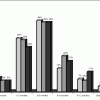
In this month's Executive Update, we continue our look at the issues surrounding the debate over agile versus heavy methodologies, drawing on data from Cutter Consortium's ongoing surveys.
Executive Report
XML and Distributed Computing Architectures
The Extensible Markup Language (XML) represents a simple initiative to provide a data representation for the Web. In just a few short years, XML has revolutionized data and communications across the Internet. XML is now a flexible data storage medium for delivering specialized content to browsers and handheld wireless computing devices.