


Strategic advice to leverage new technologies
Technology is at the heart of nearly every enterprise, enabling new business models and strategies, and serving as the catalyst to industry convergence. Leveraging the right technology can improve business outcomes, providing intelligence and insights that help you make more informed and accurate decisions. From finding patterns in data through data science, to curating relevant insights with data analytics, to the predictive abilities and innumerable applications of AI, to solving challenging business problems with ML, NLP, and knowledge graphs, technology has brought decision-making to a more intelligent level. Keep pace with the technology trends, opportunities, applications, and real-world use cases that will move your organization closer to its transformation and business goals.
Insight
In February, Microsoft will officially begin to ship the first release of its new Windows 2000 series of operating systems. (It's important to keep in mind what the marketing wordsmiths at Microsoft have done. They have said they were renaming NT 5, Windows 2000. But in fact, they are releasing at least three versions of Windows 2000.
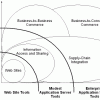
ENTERPRISE APPLICATION SERVERS by Paul Harmon
In the February 1999 issue of CDS, I provided an overview of the application server market. I began by saying it was very confusing -- I'd say exactly the same thing today.
Executive Update
e-Business: A Snapshot of Your Competition
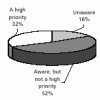
This update comes straight from the e-business trenches: Cutter Consortium recently conducted an e-business survey of 134 companies from around the world. Complete results are contained in the written report, entitled e-Business: Trends, Strategies, and Technologies . Selected findings from the report are presented below.
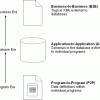

EXTENSIBLE MARKUP LANGUAGE by Jim Highsmith
Run for the hills!
OBJECTWATCH NEWSLETTER NUMBER 24:
Focus on Distributed Component Technology
Only recently have most companies started to seriously consider the changes they must make to their core information systems in order to successfully deploy major applications on the Internet, intranet, and related forms of open distributed computing. Companies were largely caught flat-footed by the rapid rise of the Internet and are having a tough time playing catch-up.
In 1997, IMA, a well-known independent software vendor of large-scale, high-volume customer interaction center (call center) applications, made a conscious decision to re-architect its entire software line and its software development organization around component technology and open distributed computing.
As most readers know, reengineering was a popular management concern at the beginning of the 1990s. Reengineering was largely a response to data that indicated that companies had spent vast amounts of money on computers yet received little back in the way of increased productivity.