

The structure of the IT organization is an important factor in supporting a company's ability to respond to market forces and compete effectively. Clearly, IT should be organized in a way that will deliver the most value to the firm, but choosing an organizational structure is not easy. Next month, we'll examine the different organizational choices for IT so that you can determine which one will work best for your company. Is your primary strategic objective profit? Asset utilization? Growth? Find out which IT organizational structure best fits each of these strategic directions. Learn how pairing business product teams with their own dedicated IT units can produce high-output team velocity combined with ever-growing domain knowledge and experience. Finally, discover how adopting a sports team's approach to recruiting, specialized positions, coaching, and retention can turn your IT organization into a winning franchise.
For each organization, there is an optimal way to organize. Ideally, an organization design should restructure the organizational infrastructure, aligning it to the business strategy to enable achievement of results.
For IT organizations, "results" mean delivering complex systems and services quickly, reliably, and at a reasonable cost to the businesses they support. In today's technology-enabled businesses, quick and successful adoption of new technology can make the difference between success and failure in the marketplace, where a competitive edge can be established or lost in weeks. In pursuit of this edge, IT organizations are frequently the target of efforts to reorganize to improve organization performance. Unfortunately, leaders of such reorganizations frequently fail to devote sufficient attention and resources to creating and implementing an optimal organization design, and as a consequence, customer satisfaction, performance metrics, and other results and outcomes suffer.
BACKGROUND
A nationwide IT organization with staff in over 60 different locations and six time zones was made up of a headquarters group of 700 and an additional 600 personnel from six regional operations, which were run almost as separate companies and had their own decentralized IT organizations. Functionally organized into development, billing, operations, and corporate staff support groups, the assembled workforce of 1,300 supported a nationwide customer base with a set of mission-critical applications, largely developed inhouse. Over 350 different applications had been built, bought, and/or modified, and they were supported by an organization that grew rapidly to 3,500 people in less than four years.
The business also grew rapidly, from 7,000 people in 1997 to over 30,000 by 2003. Customer growth was similarly swift. In 1994, the company served 2.8 million customers. By the end of 2003, it had nearly 22 million customers, but it had slipped from first in its industry to third. An IPO was made and almost immediately lost value, dropping over 70% of its offering price in three years.
Increasingly unhappy partners in the business units confronted the IT organization with demands for more functionality, better and faster service, and increased reliability for their customers. It became clear that many of the problems and inefficiencies came in part because applications and services that needed to be integrated were owned by independent "silos" in the IT organization, each of which served different functional parts of the business. When the company adopted a new technology strategy based on several enterprise-wide platforms, the old structure failed. Everything would need to be done differently, integrated from the start by an organization that would need to work in integrated, interdependent ways.
THE CIO'S CHALLENGE
Use of External Experts
An earlier IT reorganization initiative had attempted to create a program management organization (PMO), which was intended to break down the silos and improve collaboration. The PMO was essentially ignored by the existing IT functions, however, and the attempt failed. Following this failure, the company's recently appointed CEO retained the services of a major IT consulting firm to address the implementation of a major new customer relationship management (CRM) system. The CIO hired Tracy's firm, CoastWise Consulting, Inc., to assess the organizational issues in IT that were contributing to the problems.
ANALYSIS AND RECOMMENDATIONS
The big IT consulting firm delivered a 70-page PowerPoint deck that suggested major surgery: relocation and consolidation of all operations into two locations, outsourcing and possible offshoring of network operations and support functions, replacement of the current CRM development team with consulting firm personnel who had experience with the new system, and a radical restructuring of what remained to reduce the headcount by 50%, or 1,800 jobs.
CoastWise was asked to conduct an organization assessment to determine why the first reorganization was unsuccessful and to recommend a different approach that would enable the required changes. Working first with the CIO's leadership team, CoastWise identified the need to reframe and redesign relationships with the business units, since their satisfaction with the IT organization had continued to decline, as well as to assist the leadership in transitioning from a stovepiped functional organization to a true, integrated PMO. Working closely with an internal organization development (OD) consultant, CoastWise found that the organization changes required to support and enable the new technology strategy, including the requirements of a new CRM capability, called for a complete redesign of the IT function along with a comprehensive implementation plan. One of the shortcomings of the previous restructuring activity was the lack of a well-planned and well-implemented change process.
The recommendations made by the two consulting firms constituted alternatives for how to address the IT organization's problems, although there was some overlap. Both firms identified the need to significantly reduce the number of sites (and with them, cost and cumbersome infrastructural overhead), and both identified the need to restructure/redesign the organization in order to implement major organization changes. The IT consulting firm also recommended that the CRM development initiative be run with its (rather than the client company's) leadership resources, while cannibalizing labor from the client company. The possibility of outsourcing the IT function, in whole or in part, was also considered.
The CIO, in consultation with the CEO, ultimately decided to undertake the comprehensive redesign. Many of the recommendations the IT consulting firm had made were incorporated in the constraints that were prescribed by the CEO and given to the design team as design requirements. The company chose not to use the IT firm's personnel to run the CRM project because many in IT considered their consultation on the management of the project unsatisfactory. Furthermore, outsourcing was seen as an extreme, risky, and premature solution, especially in a business that was entirely dependent on IT-enabled customer products and solutions. It was also at odds with the corporate culture and would have posed significant risks to the running of the business.
REDESIGN STRATEGY
On the recommendation of CoastWise and the internal OD consultant, the CIO and CEO chartered a high-powered, cross-functional design team representing multiple elements of the IT organization to design the structure according to specific design criteria and to develop the implementation plan. The team was drawn from the "best of the best" of the second tier of IT leadership; only one member was from the CIO's leadership team.
The design team members were chosen for their demonstrated willingness and ability to work across organization boundaries on behalf of the enterprise, their knowledge of and ability to work at the systemic level, and their demonstrated competence and performance. They were also selected to provide representation from among the various functions of the IT organization, including customer service, billing, program management, operations, and development. Prior knowledge and experience of organization design were not important criteria, while curiosity and willingness to learn about this discipline and thoughtfully apply it were.
THE CEO'S CONSTRAINTS
The new CEO imposed additional requirements on the IT organization based on the report of the major consulting firm, and with them, constraints on the design. They included:
- Consolidate sites from 60 to two.
- Reduce applications from 350+ to <200.
- Create a single back office.
- Drive out US $400-$500 million of operating expense and capital costs -- a 40% reduction.
- Keep options open, including aggressive use of alternative sourcing.
Most of the design team members believed initially that it would be impossible to satisfy the conditions imposed by the CEO while also transforming the IT organization consistent with the technology requirements for the CRM system and those elements of the existing systems needed to support the various business units' strategies. The CIO was very aware that his business customers had decided that IT was "the problem" and that his time to engineer a turnaround was limited.
THE DESIGN PROCESS AND METHODOLOGY
In organization redesign, it is important to pay attention to both the process of doing the design and the design itself. Organizations are large, complex systems, and an effective redesign must address all elements of the system. Focusing on any of the design elements separate from the other interdependent components of the system often results in a less than optimal design that is difficult to implement successfully. Redesigning or tweaking one element without considering the systemic impact on the others and either rebalancing or redesigning them frequently leads to unanticipated, and often undesired, secondary outcomes. It is essential that the design of all the elements fit together to address the design criteria and optimize the infrastructure for results.
DESIGN PROCESS
Typically, in restructuring, the tendency is to "just do it" (often on the proverbial napkin), launching directly into drawing lines and boxes without understanding the significance, complexity, or organizational requirements of the activity and without regard for the requirements of implementing the solution. These errors account for most failures of reorganizations. What works better is to involve in an overall design process a group of people who are knowledgeable about the subject organization and the business environment, savvy about organization dynamics and culture, and seen by others as professionally competent and politically neutral. Thoughtfully articulated design requirements and careful attention to each step in the process and each design element are important in creating a robust and implementable design.
DESIGN METHODOLOGY
All models of organization design identify components that must be recognized and designed individually and in relationship to all the others. One such model that we like is the Star Model, which has five elements: Strategy, Processes, Rewards, People, and Structure (see Figure 1). These elements are connected to show they must be approached together, systemically. The starting point is always Strategy, since each component -- and ultimately the overall design -- should mirror and enable the achievement of the organization's strategy.
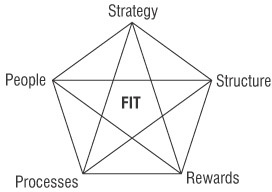
Figure 1 — The Star Model [1].
Strategy is the element from which all other aspects of the organization design flow. It includes the mission (why the organization exists and what its overarching objective is), vision (the desired future state and what will be different as a result of the organization's contribution), goals and objectives, tasks, and values. It defines where "there" is for an organization and also provides the map to the destination, including the possible and preferred routes and the various stopping-off points along the way.
Structure determines what the basic units of the organization will be, based on the required functions of the organization. It also specifies reporting relationships, levels of management, the placement of power and authority, work design, and the relationship of functions, groups, operations, and tasks to each other and to various stakeholders.
Processes provide the means by which integration occurs. They specify how the differentiated parts of the organization will interact to provide the necessary, coordinated outputs. Processes that are intentionally designed will increase the organization's ability to perform well on the dimensions of speed, cost, quality, and innovation. They include both business processes (e.g., order fulfillment, financial reporting) and processes that enable human interaction or manage the interface between employees and the business (e.g., decision making, communication). These processes enable the knowledge and abilities of many to be applied to complex challenges that require the expertise of multiple specialties for resolution.
The People element ensures that the organization's culture and the contract between workers and the company are mutually beneficial. It includes how and by what criteria people are recruited and hired, how they develop and maintain the necessary skills and competencies, and how they are valued and managed.
Rewards and other incentives of all kinds connect individual motivation, behavior, performance, and, ultimately, results to the various forms of compensation and recognition that are received in exchange. Rewards systems also convey very powerfully the underlying principles about how people, their contributions, and the goals of the organization are created, linked, and communicated; how each employee's contribution is tied to organization results; and how performance is managed and appraised.
Within each component, there are questions that must be asked, and the answers must be incorporated into the design solution. It is equally important that the lateral processes required to integrate all the different pieces be identified and designed as well. Finally, the parts and the emerging whole design must be continuously tested against each other and the design criteria for their ability to plug-and-play and contribute to the requirements and overall outcomes.
GETTING UNDERWAY
The organization redesign was a daunting assignment, but all of the design team members were there willingly and were energized by the task. At the outset, we invested in a formal team startup process during which the team members agreed on such things as how they would work together, how decisions would be made, their timetable and meeting schedule, and so on. We also provided an overview of fundamental organization design theory, methodology, and practices, augmenting it throughout the process with just-in-time conceptual and content inputs.
The design team met half-time (while still fulfilling the requirements of their regular jobs) for three months. At the outset, they spent considerable time understanding, clarifying, and negotiating their charter; meeting with key customers; elaborating and deconstructing the design criteria and CEO's constraints; and refining their understanding of the organization design process and how best to use it. They met with internal stakeholders from across the company to ensure that the scope was sufficiently comprehensive and that their business partners supported changes in the IT function. At the same time, the team crafted a visionary statement of the IT function's value proposition and detailed design criteria that would guide their work and outcomes.
DESIGN TEAM ROLES
Given its charter, the organization issues being addressed, the design criteria and CEO's constraints, and team members' respective areas of functional expertise, the design team elected to work as a committee of the whole. This meant that, in almost all cases, the team members conducted the discussions, trial designs, and tests against criteria together. While the external consultant (and to some extent the internal OD consultant, who was also a member of the team) provided facilitation and content expertise, the group consciously chose not to have a formal leader from among its members. This freed each of them to participate as equals, fully and openly, within their team agreements.
Some members took on specific enabling roles for the team. A program manager agreed to create the formal project plan for the team and its work and to track and manage the team to the plan. The internal OD consultant became the recorder and keeper of the group's work and archives. Using Visio, he also supported the team's process analysis work, enabling the team to model and present a unique design solution graphically.
Team members, individually and in subgroups, often did offline work in between team meetings. The team maximized this approach to its work by providing clear, explicit assignments for such "homework," frequently asking that a concept that the team had discussed and agreed to be further researched or elaborated. This arrangement also enabled the team to use its time together most effectively and efficiently.
The team had two sponsors, the CIO and the CEO. The team met with them (separately and together) to review its progress, to test the feasibility of aspects of the design, and to apprise them of potential risks and tradeoffs that resulted when certain of the design criteria and constraints were translated into actual design components and potential organization structure and change-related scenarios.
THE DESIGN SOLUTION
Value Proposition
It was especially important for the team, their sponsors, and IT stakeholders in the business units to understand and agree on the ultimate purpose and future direction of the IT function, as envisioned by the team and captured in the following "IT Value Proposition":
We deliver integrated solutions at competitive cost, quality, and speed based on our intimate knowledge of [the company's] business practices and its technical system architecture.
The team recognized that the current organization structure was designed to give each of the business units its own unique solutions. These were very expensive to maintain and hard to integrate. A new organization structure would need to be able to deliver integrated solutions that worked together seamlessly across the business units. It would also need to deliver the value proposition end-to-end with clear accountability. And the business units would have to believe that the new IT could deliver.
THE DESIGN CRITERIA
The team members identified the requirements that they believed would best support IT's business and technical strategies and the corporate strategy. The redesigned IT organization must:
- Deliver integrated solutions
- Provide business customers with the needed functionality of IT
- Employ vendor management
- Do work in integrated cross-functional teams
- Deliver fully integrated infrastructure solutions
- Use multiple sourcing strategies
- Manage the intake of work effectively
The CEO's design constraints added further design criteria. These specified an IT organization that would be more efficient while still serving the unique needs of the business customers, have standardized back-end processes internal to IT, and expand or contract depending on work and skill requirements.
Design Alternatives -- Theoretical and Actual
The design choices for an internal organization are not infinite. They are:
- Functional (organized around operations)
- Geographical (organized around markets)
- Customer-facing
- Hybrid (which can take many forms)
Given the design criteria, the team was limited in its design choices. For example, the determination was already made that there would be only two geographic locations (one of which was primarily the systems back-up site), that a significant reduction in spending was necessary, and that there would be a single back office. Thus, the design team elected to create an organization with a strong business or internal customer-facing element governed in a Solutions Office to manage the intake of work, backed up by a highly scalable "resource management" element organized by using project and program management methods and tools. Instead of accepting multiple projects through different functional channels that would compete internally for resources, the Solutions Office would prioritize and plan with the business customers at the front end.
The modular design of the elements was a key feature. It enabled a fully scalable organization that could expand or contract to support evolving business needs. In addition, the forward-looking strategic functions -- architecture, sourcing, and strategic planning -- were separated from the operational ones so that they could do their work without being driven by operational agendas.
A critical requirement of organization design is the identification and creation of lateral integration processes. These are the "glue" that holds together the parts in complex organizations. The tendency in today's large, complex, and highly differentiated IT organizations is for the separate functions to form silos or stovepiped organizations, each with its own customers and development and delivery arms, serving the enterprise as dis-integrated parts rather than as an integrated whole. Without the integrating structures and mechanisms, the pieces become increasingly separate and independent, often duplicating work that could be provided centrally at lower cost.
The design team was deliberate about examining the processes by which new development was begun in order to identify where the critical resourcing and capacity decisions needed to be made and to smooth out the flow of new projects into the organization. It paid equal attention to sustainment work on existing systems that would be retained and small projects that were necessary for the business but might not have the sponsorship that the large new projects received.
DRAWING THE NEW "BOXES"
The design itself met all of the specifications of the design criteria while also allowing for imposition of the constraints identified by the CEO. As shown in Figure 2, the new IT organization consists of three main components: Strategic Functions, Solutions Office, and Resource Management. The role of the Strategic Functions is to:
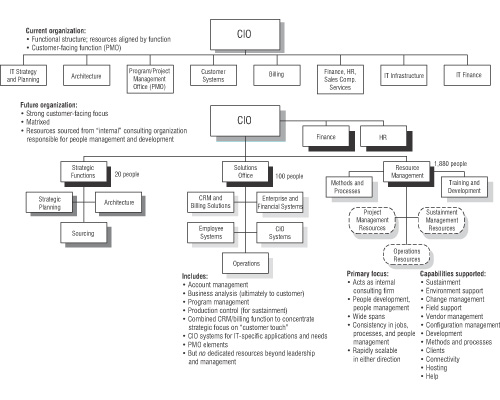
Figure 2 -- The current and redesigned IT organizations.
- Anticipate technology change
- Link with the company's strategic planning functions
- Identify external resources to provide staff for scalable operations
The Solutions Office is:
- Customer-facing and chartered to define and plan for integrated solutions
- Accountable to the business customers for results
- A single work intake and prioritizing process
The Resource Management organization must:
- Source, by whatever means necessary, the capability to design, deliver, and support solutions, including outsourcing to manage capacity
- Manage access to talent and expertise
- Maintain the inventory of skilled staff around which delivery teams can be built
WHAT THE NEW STRUCTURE DELIVERS
The design team worked hard not to lose sight of the target benefits, and even as it was involved in some of the more complicated aspects of process analysis, it kept its focus and consistently tested its activities against its goals and the design criteria. As a result, it was able to articulate very simply and succinctly the new organization design's features and benefits:
- The new design is a customer-facing organization that is tied to the delivery of integrated solutions.
- Quality, cost, and delivery have a single point of accountability that directly faces the customer.
- The design collapses multiple work request processes into an integrated work intake methodology, instilling discipline in both IT and the business.
- The new design is scalable to support evolving business needs.
- Resources are pooled to drive efficiency, consistency, and cost reductions.
- Resources are arrayed to enable fully flexible sourcing strategies.
IMPLEMENTATION: THE ULTIMATE CHALLENGE
The team spent the last three weeks of its time on the implementation plan, which included strategies for informing the organization about the design, transitioning members of the existing organizations into the new design, and training people in how to quickly and effectively set up a new or temporary team and, in the basic team, maintenance and operations skills necessary for a flexible organization. One of the difficulties the existing organization faced constantly was the inability of teams formed across internal structural boundaries to rapidly achieve high performance. The new design depended on being able to form teams quickly, which is a learnable skill. The plan contained a series of steps, specifying that communication and implementation of the structure elements would take place over the first quarter, with additional support for reassignment and team training over the following two quarters.
THE BEST-LAID PLANS ...
Just as the organization was ready to accept and begin the implementation of the design team's recommendations -- they had been fully accepted by the CIO and CEO -- a new CIO was recruited and installed, requiring the team to make its case for the organization change plan to him. While he arrived with many of his own ideas about how to "fix" the organization, including the installation of his own leadership group, he listened to the team through two lengthy presentations, eventually agreeing to the design, the principles of the change process, and the ongoing involvement of most of the members of the design team in the implementation. However, he insisted that the new design be implemented on a much more aggressive timetable (reducing it from over nine months to just three) and rejected almost all of the recommendations about training the workforce.
Two things stood out as the team moved into implementation. The first was that because the original design team members were selected from the management level below the VPs who reported to the former CIO, they were free enough from the political shadow of the old leadership team that the new CIO trusted them to carry out the implementation. The second was that by designing an organization that was as scalable as possible, the new CIO could achieve his apparent charter to aggressively cut costs while maintaining service levels. The design gave him more freedom with which to meet his critical goals.
While the replacement of the old CIO and the prompt replacement of five of the six VPs reporting to him sent shockwaves through the IT organization, it also rapidly unfroze the existing system and increased its readiness to accept change. The implementation ramped up quickly. The organization design was rolled out in a series of meetings, with the design team taking the lead in presenting to managers across the IT organization. The absence of meaningful training to support the change meant that the shift to the new organization met some resistance from workers, and not all of them were well equipped to do their new jobs. Interestingly, critics of the design fixed on the new CIO as the "cause" of their concerns!
THE BEST-LAID PLANS ... PART II
Because cost objectives were being met, senior management considered the changes successful. What remained to be seen was whether the business partners of IT would be satisfied with the redesigned organization -- something that would require more time to realize.
In the end, however, the entire project was impacted by even greater changes. System failures in both the legacy systems and the implementation of the new CRM system intended to replace many of them caused a significant loss of customers during the last quarter of the year. Shortly thereafter, the company was unexpectedly put up for sale and was acquired in a buyout/industry consolidation.
YOU CAN'T ALWAYS GET WHAT YOU WANT
(But If You Try Sometimes, You Might Find You Get What You Need)
This is a classic example of good work being overtaken by events. It shows the need to address organization problems early, before "the platform is burning" and the responsibility for action gets taken out of the organization's hands. Redesign is difficult and time-consuming to do well, and it is often not undertaken until things have gone from bad to worse. It's not an accident that many redesigns address structure alone. Some action appears better than none, and moving boxes on an organization chart feels like major change even though it alone rarely achieves or sustains the needed or desired results.
In this case, even though the design process and result were not fully successful as originally envisioned, they proved to be worth the investment of time and effort. The new design produced a win by handing the new CIO the means to create a highly scalable organization that would do a better job of working with the business units to prioritize and deliver on mission-critical IT work. It did that by using a rigorous design process and design team members who didn't have the political stake in the outcome that the existing leadership would have had, and by ensuring that all of the elements -- strategy, structure, people, processes, and rewards; key processes; and sources of organization integration -- were methodically addressed.
The new organization model was able to scale quickly and realize significant cost savings, though not without human impact. Much of this was done through selective outsourcing. What the design contributed were processes and criteria upon which to base and manage the outsourcing with minimal disruption to operations.
The design team became part of the leadership team of the new organization; many of them were engaged in the subsequent acquisition transition and outlasted the new CIO, who was gone in little more than a year. Most of these individuals cite the experience as one of the best of their professional lives, even though it was both stressful and not fully successful in all the ways they had hoped.
REFERENCE
1. Lawler, Edward E., III. From the Ground Up: Six Principles for Building the New Logic Corporation. Jossey-Bass, 1996.
ABOUT THE AUTHORS
Tracy C. Gibbons is President of CoastWise Consulting, Inc., an organization design and development consulting firm with offices in Silicon Valley. CoastWise creates competitive advantage for its clients by leveraging the power of organization design, strategic alignment, and collaboration. Dr. Gibbons has been an organization development consultant for more than 25 years. Her clients include JDS Uniphase, Lawrence Berkeley National Laboratory, Millennium Pharmaceuticals, Applied Materials, Pitney Bowes, and NASA. She was employed at Digital Equipment Corporation and Advanced Micro Devices as a Senior OD consultant and manager. She holds a PhD in human and organization systems from Fielding Graduate University.
Dr. Gibbons can be reached at CoastWise Consulting, Inc., 650 Castro Street, Suite 120-332, Mountain View, CA 94041-2068, USA. Tel: +1 650-969-3535; E-mail: tracy@coastwiseconsulting.com; Web site: www.coastwiseconsulting.com.
H. Randall Webb is an internal organization development professional who has worked with high-technology organizations for over 20 years, including 11 years at Digital Equipment Corporation as a Human Resource Business Partner and as a Senior Organization Consultant. He is currently working with the PEMCO Financial Services companies as a senior HR Compensation Consultant, designing and implementing a new performance-oriented compensation system. He holds an MBA from Whittemore School of the University of New Hampshire and a master's degree from Fielding Graduate University and has taught organization development and theory at the University of New Hampshire, Babson College, and City University of Bellevue, Washington, USA.
Mr. Webb can be reached at 501 23rd Ave. S., #C4, Seattle, WA 98144-2343, USA. Tel: +1 206 320 8908; E-mail: hrwebb@att.net.