


Business Transformation Requires Transformational Leaders
Leadership and teaming skills are front and center in times of rapid change. Meet today’s constant disruption head on with expert guidance in leadership, business strategy, transformation, and innovation. Whether the disruption du jour is a digitally-driven upending of traditional business models, the pandemic-driven end to business as usual, or the change-driven challenge of staffing that meets your transformation plans — you’ll be prepared with cutting edge techniques and expert knowledge that enable strategic leadership.
Subscribe to Arthur D. Little's Culture & Leadership Newsletter
Insight
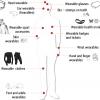

The Internet of Things (IoT) evolution in combination with progress in analytics and cognitive capabilities has resulted in new technologies, such as wearables, sensors, and intelligent automation solutions. The world around us is smarter, more interconnected, and more automated. Three major aspects of digitization are observed as a result of new economy models driven by data: digitization of humans, digitization of organizations, and digitization of the ecosystem (see Figure 1). This article focuses on the first aspect -- the digitization of humans -- and relates to the other two categories as needed.


Wearables promise a host of opportunities, from giving companies a new customer touchpoint they can use to engage directly with consumers to changing the way healthcare is provided and medical research is conducted. Already wearable devices are being used to assist employees with their jobs, and such usage is expected to advance in the near future. Wearables will make their way into business and industrial scenarios ranging from CRM and HR to the shop floor. But along with opportunities, wearables raise concerns.


This is the final installment of a three-part Executive Update series concerning key issues involving the infrastructure as a service (IaaS) model of cloud computing.


What we need is a description of hacking that omits the good/bad distinction because, as this Executive Update points out, exactly the same activities can be positive or negative. This Update provides a judgment-neutral guide to hacking to help you understand what hacking is about and how to facilitate its use (for good) and prevent its misuse.


From the time most people are able to put together their first cogent thoughts, the question arises: Who do you want to be when you grow up? It's a simple enough concept. Do we want to be firefighters? Captains of industry? Doctors? Lawyers? Astronauts? But as we achieve a reasonable level of maturity, we come to the realization that we simply want to be happy with ourselves and with the world around us.
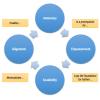


In part IV of this series, we explored how alignment leads to autonomy (see "Implementing the Integrative Framework, Part IV -- Autonomy"). We now shift our focus to empowerment as the last "ingredient" in the (Scalability -> Alignment -> Autonomy -> Empowerment) cycle. It is this full cycle that makes the integrative framework so powerful.
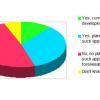
A recent Cutter Consortium survey that asked 80 organizations (worldwide) about their plans for the Internet of Things (IoT) helps provide some insight into how organizations are responding to the introduction of the Apple Watch and the growing consumer use of smart watches in general.


SEPTEMBER 8, 2015 — ARLINGTON, MASSACHUSETTS
Figure 1 -- Key characteristics of digital intelligence.