



Business Transformation Requires Transformational Leaders
Leadership and teaming skills are front and center in times of rapid change. Meet today’s constant disruption head on with expert guidance in leadership, business strategy, transformation, and innovation. Whether the disruption du jour is a digitally-driven upending of traditional business models, the pandemic-driven end to business as usual, or the change-driven challenge of staffing that meets your transformation plans — you’ll be prepared with cutting edge techniques and expert knowledge that enable strategic leadership.
Subscribe to Arthur D. Little's Culture & Leadership Newsletter
Insight
"Commodity" is a bad word among technologists. It implies standardized, unchanging, noninnovative, boring, and cheap. Commodities are misunderstood. This Advisor seeks to dispel some of the myths around the commoditization of IT services (i.e., the cloud).
Our goal on projects as the project manager should be to remain as productive as possible and use resource time and effort as wisely as possible. That way we accomplish tasks, we get work done, we don't waste time, and we go easier on the project budget. One way to help ensure productivity and budget management is to make our project meetings as productive as possible.

Architecture is becoming more visible. It is necessary to create a solution that is capable of high-speed change and linked to analytics and the increasing stream of infrastructure data that has become available from the Internet of Things. The possibilities with this new architecture are immense.
Executive Update
Being the Right Leader for the Right Team
In this Executive Update, we explore the process of building out a project team and what differentiates good and bad teams, as well as what it takes to lead that team and get it to follow you into any battle.

For too long, discussions about the value of Enterprise Architecture have been hijacked into a debate about whether or not EA is necessary. This type of discussion misses a key point: if you have an enterprise, then it must have an enterprise architecture. Enterprise architecture isn't optional.
In this on-demand webinar, Cutter Senior Consultant Roger Evernden explains why EA isn’t optional, and how the debate should be more about whether we need to actively manage enterprise architectures.
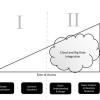
Watson Analytics provides immediate analytic processing from the cloud for business-related queries. The most interesting aspect, however, is not in its application of big data to the solution of queries -- a process that is handled by IBM's Cognos TM1 as a back end -- but in its application in simplifying the user interface and making analytics accessible to a wider range of business professionals.
The quest for knowledge has played a major part in the intellectual development and evolution of individuals, societies, and cultures. Socrates viewed knowledge as a virtue, a path to perfection. Prometheus was punished for bringing knowledge to the world, and Faust for wanting it too much.
Yet knowledge has continued to feature as a defining commodity and a sign of progress. Aristotle, reflecting the height of Greek philosophy, observed that "all men by nature desire knowledge," while Socrates proclaimed that the only good is knowledge and the only evil is ignorance.


"The annual IT trends issue deals with a very complex and hard- to-predict environment that is extremely important to our daily experience and endeavors."
—Joseph Feller, Editor
I was recently invited to give a technology forecast at a partner company's annual user conference. I agreed but made it very clear at the start of my presentation that I was going to provide the forecast in the style of Met Éireann.