


Business Transformation Requires Transformational Leaders
Leadership and teaming skills are front and center in times of rapid change. Meet today’s constant disruption head on with expert guidance in leadership, business strategy, transformation, and innovation. Whether the disruption du jour is a digitally-driven upending of traditional business models, the pandemic-driven end to business as usual, or the change-driven challenge of staffing that meets your transformation plans — you’ll be prepared with cutting edge techniques and expert knowledge that enable strategic leadership.
Subscribe to Arthur D. Little's Culture & Leadership Newsletter
Insight

IT service leaders are under constant pressure to deliver reliable and available services within the budgetary constraints of the business. They look for opportunities to optimize their support model, extracting repetitive, nonvalued inefficiencies and effort that inflate support costs. As we discuss in this Executive Update, the shift-left service strategy focuses on moving issue resolution and request fulfillment to the lowest cost level in the tiered-model service organization, with a focus on "one and done" -- providing the internal customer with resolution at the service desk (Level 1) or self-service portal (Level 0).


"The annual IT trends issue deals with a very complex and hard- to-predict environment that is extremely important to our daily experience and endeavors."
—Joseph Feller, Editor
I was recently invited to give a technology forecast at a partner company's annual user conference. I agreed but made it very clear at the start of my presentation that I was going to provide the forecast in the style of Met Éireann.

Not so long ago, the top conferences attended by IT professionals revolved around organizations sharing arcane technical aspects of particular technologies or venues where manufacturers tipped their R&D hand to loyal purchasing departments. Some of these gatherings have gone by the wayside much like some of the information systems highlighted in them (e.g., COMDEX).

DARE TO BE DULL?
A picture is truly worth a thousand words. As I write this, I'm looking at the results of Cutter's 2015 IT trends survey and musing over the observations of my CBR co-contributor Cutter Senior Consultant Dennis Adams.
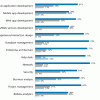

This survey explored interest in and adoption of various relatively new IT technologies and initiatives and investigated staffing and outsourcing trends in 80 organizations worldwide. Fifty percent of responding organizations are headquartered in North America, 19% in Asia/Australia/Pacific, 14% in Europe, and 11% in Africa, with the remainder in South America and the Middle East.

Change is risky. The decision to change or not change needs to be based on a risk-versus-reward analysis supported by executive sponsors. Some change will occur based on necessity. Many IT organizations are adopting DevOps practices bottom-up because the burden of delivering and the overhead for maintaining current systems is affecting their physiological and psychological well-being. However, businesses should view this as a leading indicator of the need for further change.


The long-time hiring vs. training debate has been energized by an influx of new technologies requiring new skills. Today's IT departments constantly struggle to meet the skill and experience requirements of new projects, new development platforms, new languages, new environments, and new infrastructure. The advantages of hiring are that it makes it possible to immediately bring in new skills and new perspectives -- often from people who have some familiarity with the industry and may have worked with competitors. This is offset by a range of serious disadvantages.


In this Update, we explore how to collect and communicate contextual information, increasing the odds that customers will see value in software and willingly adopt it. The same principle applies to contextual information that applies to any kind of requirements insights: the type of information needed, and the medium for communicating it, varies according to the question asked. Therefore, software professionals need to develop a toolkit of techniques that will vary across teams, projects/products, organizations, and time, since the same questions do not arise for everyone.