Business Transformation Requires Transformational Leaders
Leadership and teaming skills are front and center in times of rapid change. Meet today’s constant disruption head on with expert guidance in leadership, business strategy, transformation, and innovation. Whether the disruption du jour is a digitally-driven upending of traditional business models, the pandemic-driven end to business as usual, or the change-driven challenge of staffing that meets your transformation plans — you’ll be prepared with cutting edge techniques and expert knowledge that enable strategic leadership.
Subscribe to Arthur D. Little's Culture & Leadership Newsletter
Insight

Today, cloud services are the reincarnated, super-charged version of ASP. In the current decade, cloud has proliferated into many derivatives of XaaS, or "anything as a service" (e.g., SaaS -- software as a service, PaaS -- platform as a service, IaaS -- infrastructure as a service, and DRaaS -- disaster recovery as a service). The derivatives of XaaS are many and increasing daily. There are so many forecasts, it's impossible to determine the market size and growth trajectories.


Last January, I discussed important new developments in IBM's Watson natural language-based analytics question-and-answering system (see "IBM Bets the Future on Watson").



In this on-demand webinar, Glazer addresses how high-performance operations successfully use probabilistic decision-making approaches instead of deterministic approaches. You'll discover how you can obtain performance data change from a deterministic approach to a probabilistic approach that uses performance prediction models.


In this issue on healthcare IT, we explore the field’s potential and examine how we can address the issues and challenges that IT and the healthcare industry face in realizing the promise of healthcare IT.
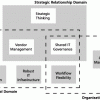
Many healthcare CIOs find themselves caught between technological imperatives and public policy on one hand and internal resistance to change on the other. Some healthcare CIOs who have undertaken massive, IT-driven transformation efforts are confronting serious challenges, from technological hurdles to their own staff's determination that patients, not processes, remain the foremost priority. What many institutions have created is a hodgepodge of healthcare IT (HIT) systems that partially automate their operations and processes without regard to the long-term benefits of these systems. Despite implementing mammoth electronic medical record (EMR) systems and building a host of advanced clinical systems, healthcare CIOs often have been dismayed to find that many of these projects fail completely or don't bring about the desired results.
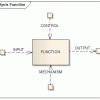
Currently, software systems in the healthcare domain are not sufficient to alleviate this crisis. Most of those systems are not extensible or scalable, and they have little interoperability. In this article, I will show how IT analysis methods can help alleviate the crisis by providing tools to build IT software systems that will reduce cost and complexity in the healthcare domain.