


Business Transformation Requires Transformational Leaders
Leadership and teaming skills are front and center in times of rapid change. Meet today’s constant disruption head on with expert guidance in leadership, business strategy, transformation, and innovation. Whether the disruption du jour is a digitally-driven upending of traditional business models, the pandemic-driven end to business as usual, or the change-driven challenge of staffing that meets your transformation plans — you’ll be prepared with cutting edge techniques and expert knowledge that enable strategic leadership.
Subscribe to Arthur D. Little's Culture & Leadership Newsletter
Insight





The statistics I have seen recently give me a euphoric feeling about the pace of Agile adoption. However, I feel that most of the so-called "Agile projects" are just the "water-Scrum-fall," which no one is willing to admit. I could list various reasons behind the failure, but one thing that stands out clearly is a poor Agile adoption strategy.


As business professionals we're trained (or born) to value data and analysis. Despite a plentitude of data and analysis, however, many decisions do not result in the desired outcome. The problem, as I'll describe in this Executive Update, is not about the volume of data or days of analysis; it is the data and analysis mindset itself.

Depending on their maturity (as determined by the Social Media Maturity Model we describe in Measuring the ROI of Social Media and Social Media Analysis Investments, companies can leverage the advantages of social media using the 4C strategy, which consists of Content, Communication, Community, and Collaboration (see Table 1):
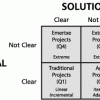
This Executive Report suggests temporary fixes that can be adapted by project managers constrained by traditional models when facing Agile projects. These fixes include: management reserve, a bundled change-request process, and integrated release strategies. The report also provides an enterprise-level permanent solution for the effective management of Agile and other complex projects.
Today there are still many project managers trapped in traditional linear project management models such as the standard waterfall or rapid development waterfall. When these managers encounter complex projects using these models, they put project success in harm's way. They try to force fit these complex projects into their linear models with marginal results. If you are a project manager facing this situation, what can you do?