



Business Transformation Requires Transformational Leaders
Leadership and teaming skills are front and center in times of rapid change. Meet today’s constant disruption head on with expert guidance in leadership, business strategy, transformation, and innovation. Whether the disruption du jour is a digitally-driven upending of traditional business models, the pandemic-driven end to business as usual, or the change-driven challenge of staffing that meets your transformation plans — you’ll be prepared with cutting edge techniques and expert knowledge that enable strategic leadership.
Subscribe to Arthur D. Little's Culture & Leadership Newsletter
Insight


As the workforce becomes better educated, more technology-savvy, and more flexible in handling job assignments, the pace of change will increase. Development of new management styles is now becoming imperative. These emerging management styles are already beginning to demonstrate significant benefit across a growing range of activity.


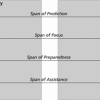
Traditionally, risk management is advocated and assumed to be a self-evidently correct framework. It offers a planning method for individual risks yet ignores systemic, complex risk and uncertainty. Often, ways of managing risk are established based on compliance with process. The process itself and its application are not themselves questioned.


SURVEY DEMOGRAPHICS
This survey examined whether and how organizations are implementing and managing API programs, the drivers behind such programs, the factors that make for a successful API strategy, the challenges and risks, and deployment strategies and value creation. Sixty-one percent of the 152 responding organizations are headquartered in North America, another 20% in Europe, 11% in Asia/Australia/Pacific, 4% in Africa, 3% in Central and South America, and 1% in the Middle East.


The assumptions that programmers do semiskilled blue-collar work -- and hence that they are virtually interchangeable and can be hired and fired at will -- are reminiscent of Taylorism as it came to be understood. Yet there can hardly be any domain in which those assumptions are less appropriate than software development.
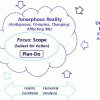

Transcending software development, this Executive Report outlines fundamental reasons for the popularity of Agile, the risks associated with the subjective element of Agile, and how to balance the flexibility with planning through a well-established Composite Agile Method and Strategy (CAMS).
The psychology of Agile discusses, in a practical way, the importance and impact of the disciplines of psychology and sociology in using and deploying Agile as an overall organizational culture. The Agile Manifesto heralded a quantum shift in the way we work: moving away from the rigors of planned, formal approaches to one that is based on collaboration, communication, and trust.