



Business Transformation Requires Transformational Leaders
Leadership and teaming skills are front and center in times of rapid change. Meet today’s constant disruption head on with expert guidance in leadership, business strategy, transformation, and innovation. Whether the disruption du jour is a digitally-driven upending of traditional business models, the pandemic-driven end to business as usual, or the change-driven challenge of staffing that meets your transformation plans — you’ll be prepared with cutting edge techniques and expert knowledge that enable strategic leadership.
Subscribe to Arthur D. Little's Culture & Leadership Newsletter
Insight


When my cofounders and I began in 2007 to create a software development services firm in Vietnam, one of our most powerful motivations was to create a shop that could support innovative projects. Outsourcing had historically been very much geared toward low-risk, low-innovation work at the large-enterprise level.


The past week has seen unprecedented leaks about the US National Security Agency (NSA) and the way it monitors the world's electronic information. The primary whistleblower has identified himself; he is Edward Snowden, who has been an NSA contractor through Booz Allen Hamilton and a former CIA technical employee.
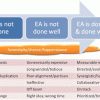

Enterprise architect teams struggle to explain and justify their role, and to demonstrate tangible, practical, and measurable benefits from their work. The rewards from architecting are seen as long-term outcomes, value from EA is not measured effectively, and EA is only seen as an optional consideration. This Executive Report shows how organizations are replacing this mind-set with one that regards enterprise architecture as essential and nonoptional.
This Executive Summary and its accompanying Executive Report set the record straight by explaining why IT organizations feel the need to justify enterprise architecture, and what we can do to prove the value from EA.
Efficiency has been the mantra of systems approaches from early work on time and motion, through the business process reengineering movement, to the latest manifestation in Six Sigma. The organization has been seen as a machine or manufacturing process to be managed through the definition and measurement of defined outcomes. In consequence, method and tools have imitated the manufacturing process: defining output, managing process, monitoring for deviation.


Ever since I began teaching IT at the university (in 1966, actually), I have wondered how best to prepare students for a professional life in computing. Of course, we called the field various things at different times and in different academic contexts: data processing, management-information-systems, computer information systems, computer science.
Efficiency has been the mantra of systems approaches from early work on time and motion, through the business process reengineering movement, to the latest manifestation in Six Sigma. The organization has been seen as a machine or manufacturing process to be managed through the definition and measurement of defined outcomes. In consequence, method and tools have imitated the manufacturing process: defining output, managing process, monitoring for deviation.