Business Transformation Requires Transformational Leaders
Leadership and teaming skills are front and center in times of rapid change. Meet today’s constant disruption head on with expert guidance in leadership, business strategy, transformation, and innovation. Whether the disruption du jour is a digitally-driven upending of traditional business models, the pandemic-driven end to business as usual, or the change-driven challenge of staffing that meets your transformation plans — you’ll be prepared with cutting edge techniques and expert knowledge that enable strategic leadership.
Subscribe to Arthur D. Little's Culture & Leadership Newsletter
Insight
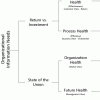
One of my friends wanted help in growing her business. As a local restaurant owner, she had received many accolades and encouragement to expand. Being a wise (and cautious) leader, she wanted first to see if the compliments she was receiving were warranted and whether her "product" was truly worthy of expansion. She didn't want to trust that her friends and family weren't just being nice. Rather, she wanted to measure the quality of her restaurant.




Executive Update
Cloud Performance Metrics and Benchmarking
For all independent service providers (ISVs) and IT service providers, developing cloud-based services are becoming an essential business model in order to be at par with competitors and to keep infrastructure and operational cost optimal.


Last month we looked at the veracity factor in Big Data, which concerns the uncertainty of input and the need to cross-check and correct it (see "The Veracity Factor"). This is important because results in streams, such as social data comments, do not yield a precise interpretation.


In a mutual boot-strapping beginning with the dawn of Homo sapiens, mankind and information have both exploded in variety, velocity, and volume. Our fates have been intertwined. We advance by harvesting, using, and sharing information. Along the way, information persists, mutates, and diffuses further.