

Business Transformation Requires Transformational Leaders
Leadership and teaming skills are front and center in times of rapid change. Meet today’s constant disruption head on with expert guidance in leadership, business strategy, transformation, and innovation. Whether the disruption du jour is a digitally-driven upending of traditional business models, the pandemic-driven end to business as usual, or the change-driven challenge of staffing that meets your transformation plans — you’ll be prepared with cutting edge techniques and expert knowledge that enable strategic leadership.
Subscribe to Arthur D. Little's Culture & Leadership Newsletter
Insight

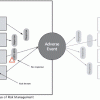
Using a case study approach, we have researched why managers often disengage from project risk management. We singled out significant adverse events for a range of IT rollout projects, projects that involved the physical provision of client-server infrastructure plus (usually) a consistent set of software applications. We asked about key risks that the project managers associated with these events, whether and why those risks were known, and what actions, if any, they took in response.


Abstract
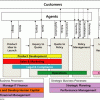
Customer focus and attention to end-to-end processes are essential to success in improving business performance. This Executive Report outlines how organizations can deploy a process-based view and thereby become more adaptive and improve business performance. The tight linkage between process management principles and business architecture enables clarity in today's complex business-IT transformation landscape, facilitating closer business-IT alignment.
Global competition, increasing customer power, and quantum advances in technology have combined to demand a new and more adaptive approach to managing the business. In spite of significant advances in methods to improve business performance, such as TQM, Six Sigma, Lean, BPR, ERP, CRM, SaaS, and the cloud, many organizations continue to struggle in executing improvements to business performance.

One reason for slow cloud adoption within the enterprise has been a justifiable fear of vendor lock-in and proprietary systems partially caused by a woeful lack of cloud computing standards. Cloud migration or onboarding has long been hampered by the lack of virtual image standardization.