



Business Transformation Requires Transformational Leaders
Leadership and teaming skills are front and center in times of rapid change. Meet today’s constant disruption head on with expert guidance in leadership, business strategy, transformation, and innovation. Whether the disruption du jour is a digitally-driven upending of traditional business models, the pandemic-driven end to business as usual, or the change-driven challenge of staffing that meets your transformation plans — you’ll be prepared with cutting edge techniques and expert knowledge that enable strategic leadership.
Subscribe to Arthur D. Little's Culture & Leadership Newsletter
Insight

If the maxim "what gets measured, gets managed" should be used to judge the use of social media in companies, then clearly the topic is moving beyond mere casual interest. Cutter Consortium's recent survey on the topic makes that abundantly clear. However, until I analyzed the results of the survey, I felt that many in industry were thinking somewhat schizophrenically. Most CIOs and business leaders I talk to are -- themselves singly or speaking for their organizations -- of two minds regarding social media.

This issue of CBR was quite interesting and a lot of fun to write about. It centers on a very timely and increasingly pervasive topic: social media, focusing our attention on the monitoring of the social media landscape by organizations. As the saying goes, and which Vince alluded to in his contribution, you can't manage what you don't measure. While the old saying may or may not be true, what is sure is that measuring is costly, in terms of time and the expense associated with the right tools.
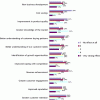

This survey investigated the extent to which and how organizations are monitoring social media. The 54 respondents are primarily from North America (52%), with 22% from Europe, 15% from Asia/Australia/Pacific, 7% from South America, and 4% from Africa.


Every development manager has faced the choices: Ship sooner? Squeeze in an extra feature? Test a little less to cut cost? Invest in infrastructure? Rewrite that problematic code? Virtually every development cycle goes through a similar set of tradeoffs multiple times in the course of getting code out the door. Every time a decision is made, the overall quality, maintainability, complexity, and stability of a software system goes up or down.


Abstract
In recent years, both the enterprise risk environment and enterprise security measures have evolved considerably. In this Executive Report by Brian J.
In recent years, both the enterprise risk environment and enterprise security measures have evolved considerably. Risk is now being brought into the fold of a unifying concept -- enterprise risk management (ERM), which attempts to consolidate heretofore siloed risk management efforts within a single, centralized structure.