Business Transformation Requires Transformational Leaders
Leadership and teaming skills are front and center in times of rapid change. Meet today’s constant disruption head on with expert guidance in leadership, business strategy, transformation, and innovation. Whether the disruption du jour is a digitally-driven upending of traditional business models, the pandemic-driven end to business as usual, or the change-driven challenge of staffing that meets your transformation plans — you’ll be prepared with cutting edge techniques and expert knowledge that enable strategic leadership.
Subscribe to Arthur D. Little's Culture & Leadership Newsletter
Insight
If the maxim "what gets measured, gets managed" should be used to judge the use of social media in companies, then clearly the topic is moving beyond mere casual interest. Cutter Consortium's recent survey on the topic makes that abundantly clear. However, until I analyzed the results of the survey, I felt that many in industry were thinking somewhat schizophrenically. Most CIOs and business leaders I talk to are -- themselves singly or speaking for their organizations -- of two minds regarding social media.

This issue of CBR was quite interesting and a lot of fun to write about. It centers on a very timely and increasingly pervasive topic: social media, focusing our attention on the monitoring of the social media landscape by organizations. As the saying goes, and which Vince alluded to in his contribution, you can't manage what you don't measure. While the old saying may or may not be true, what is sure is that measuring is costly, in terms of time and the expense associated with the right tools.
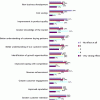

This survey investigated the extent to which and how organizations are monitoring social media. The 54 respondents are primarily from North America (52%), with 22% from Europe, 15% from Asia/Australia/Pacific, 7% from South America, and 4% from Africa.


It's amazing how organizations spend vast sums in the interest of discovering the newest, latest, and most advanced business practices and technologies. They throw their energies behind radical change, while ignoring the improvements that can be made through effective implementation of existing practice.





If social media is unimportant to a company, the company must consider that it is enormously important to its prospects and customers. But a company cannot simply tack it on and expect it to foster satisfied customers and a more innovative enterprise.